
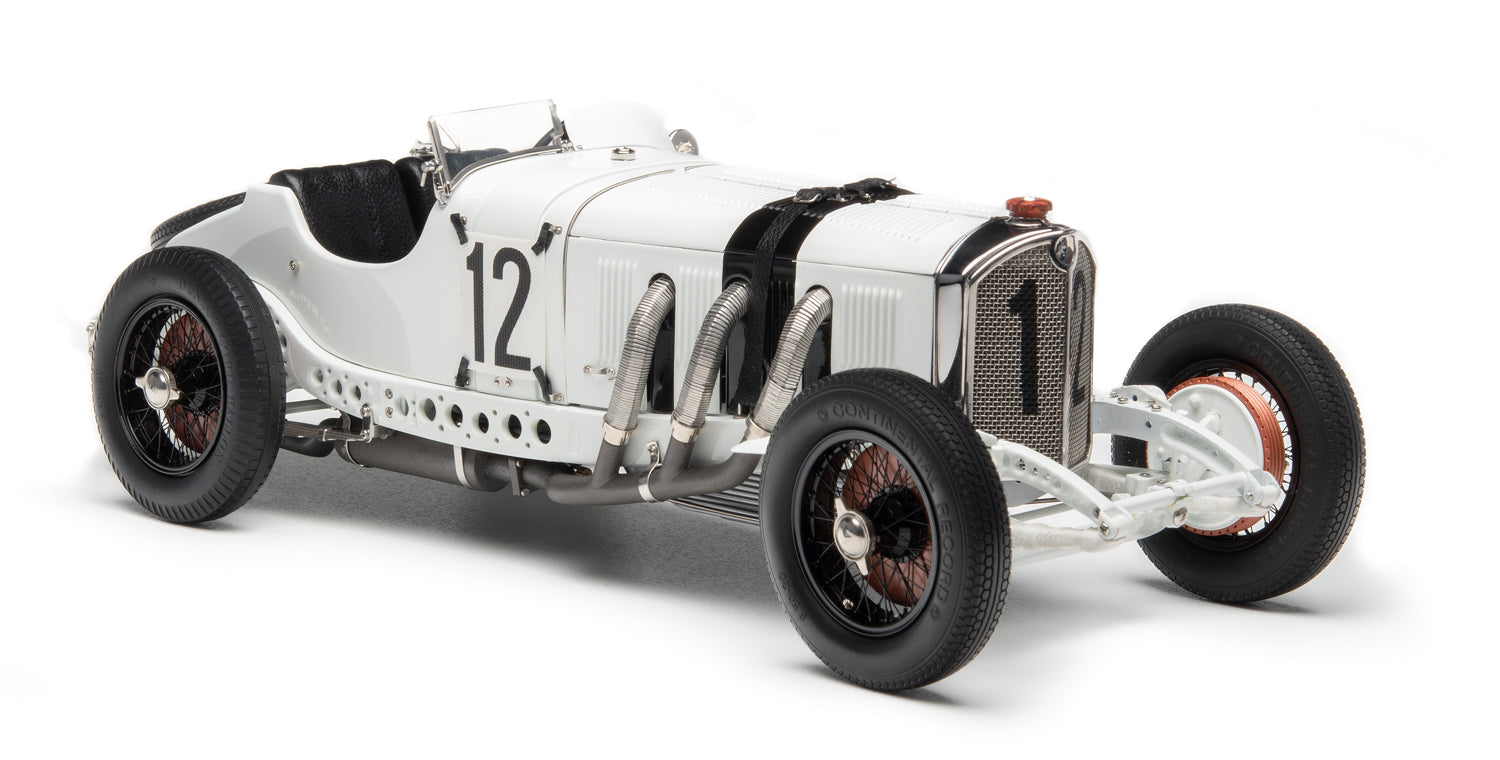
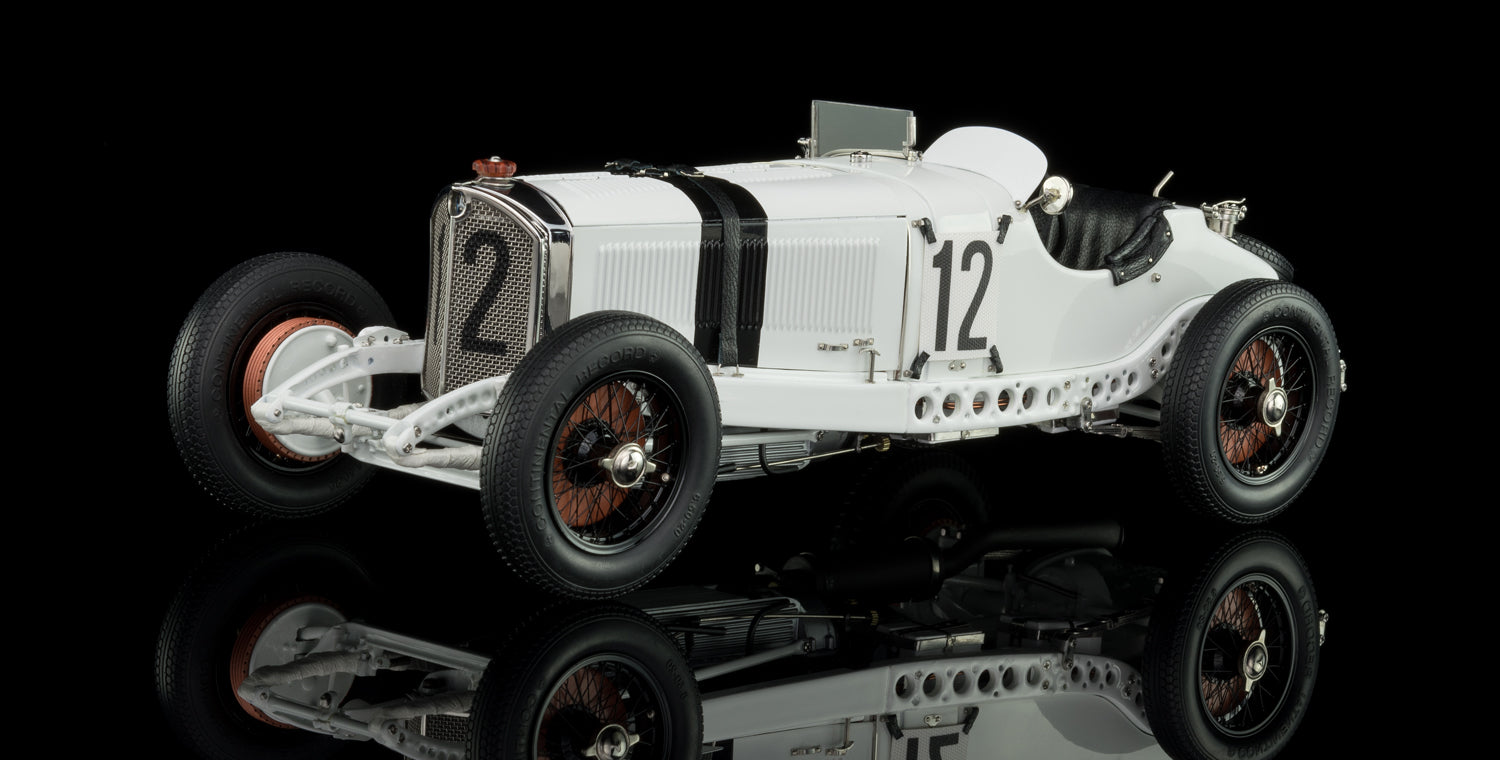
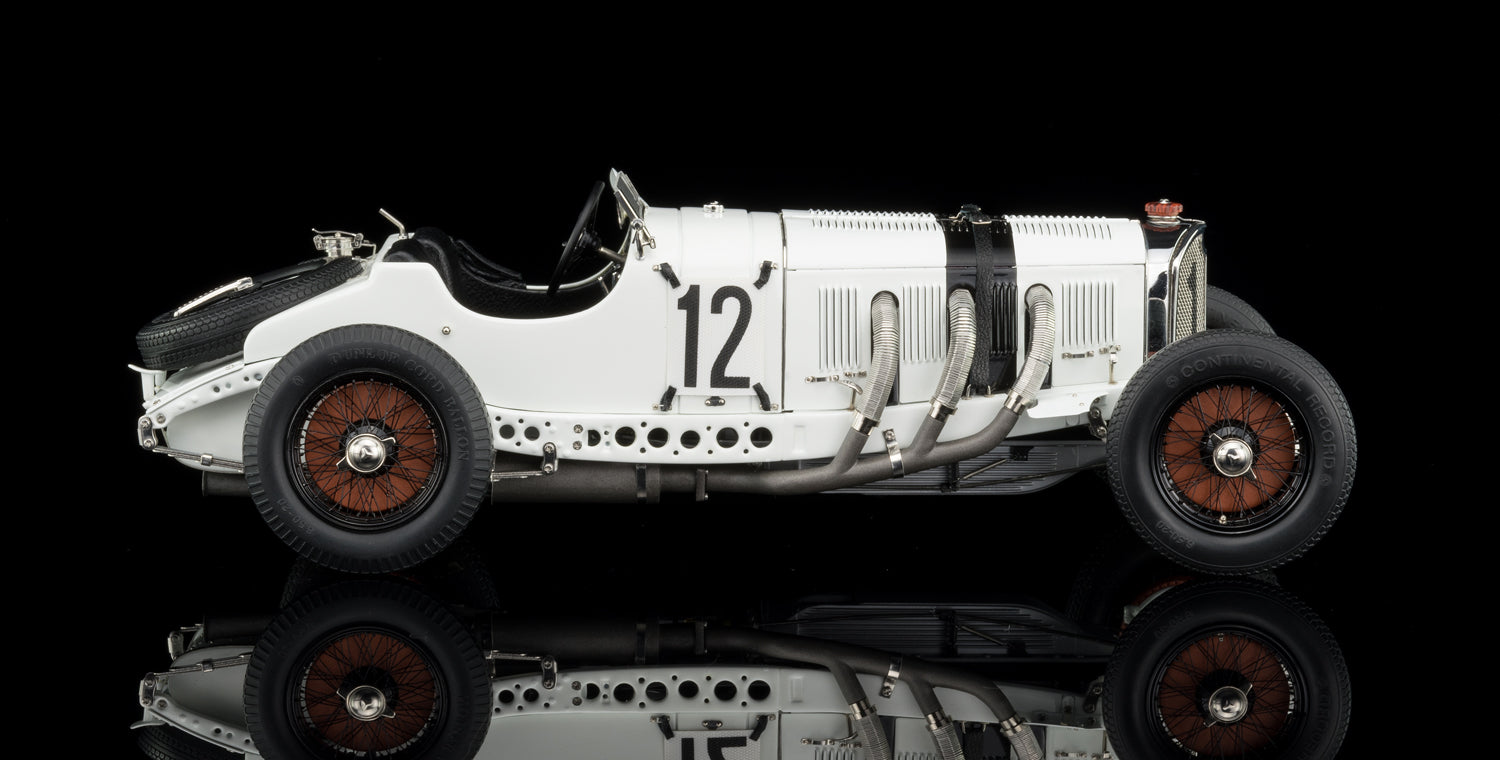
Mercedes-Benz SSKL #12 Mille Miglia 1931 Otto Merz CMC M-189 LE


Description
A unique opportunity! This model is sold out at CMC. The last units have just arrived from the CMC warehouse in China. Therefore, this model is now completely sold out at CMC and will never be available again in this limited edition version. The original retail price was €449.00.
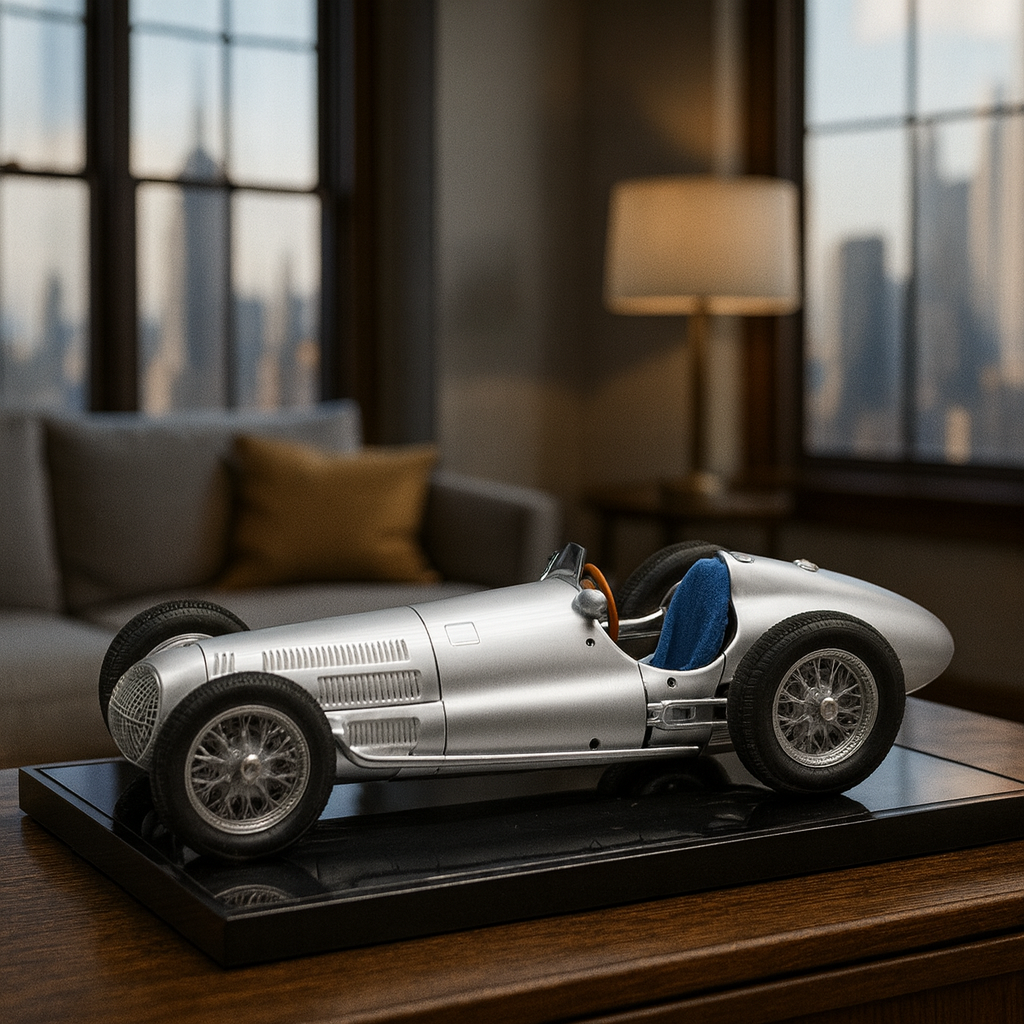
Mercedes-Benz SSKL Mille Miglia 1931 #12 Otto Merz, Limited Edition 600 pieces
Model description:
• Hand-assembled metal precision model made up of over 1700 parts
• Authentically and true-to-scale shaped body
• Original reproduction of the weight-reduced steel frame
• Radiator grille and stone chip protection grille in high-quality metal design
• Double-winged, hinged engine hood secured with leather straps
• Hood latches with spring-loaded locking hooks
• Six-cylinder in-line engine with all auxiliary components and complete routing and wiring.
• Side exhaust pipes in flexible metal hose design
• Side-mounted metal exhaust pipe
• Perfect spoked wheels with aluminum rims and hand-inserted stainless steel wire spokes, painted in satin black
• Detachable wheel center locks
• Removable spare wheel, secured with a toggle clamp screw
• Functioning metal leaf springs on the front and rear axles
• Fuel filler neck with hinged stainless steel fuel cap
• 2 movable hand levers for throttle and ignition adjustment
• True-to-scale cockpit design with leather-covered seats and fully instrumented instrument panel
• Both seats are upholstered in genuine leather
• Wind deflector on the driver's side, movable windshield on the passenger side
• Brake drums in original copper design with cooling fins
• Side starting numbers applied to textile cloth according to the original model
History:
The motorsport scene from the mid to late 1920s, and even into 1931, was dominated by one car brand: Mercedes-Benz with its legendary 7.1-liter supercharged models from the SSK series.
This race-proven racing car, also respectfully nicknamed "the white elephant" due to its untamed power and imposing size, caused a major sensation once again in 1931, together with its brilliant driver Rudolf Caracciola and teammates Hans Stuck and Otto Merz. Despite the Great Depression and the resulting limited support from the Daimler-Benz factory in Stuttgart-Untertürkheim, Rudolf Caracciola and his two teammates, Hans Stuck and Otto Merz, achieved remarkable successes, each driving a weight-reduced SSKL. In addition to Caracciola's impressive victory at the 1931 Mille Miglia, Mercedes achieved further outstanding results: Caracciola's victory at the German Grand Prix and strong finishes of fifth and sixth place, respectively, by Otto Merz and Hans Stuck in the same race.
CMC has already launched the “Caratsch” winning car with starting number 8 as a model in recent years.
For the year 2018, we want to revisit the German Grand Prix on July 19, 1931, which was held on the Nordschleife of the Nürburgring, and pay tribute to the two Mercedes drivers Otto Merz and Hans Stuck with their SSKL racing cars by each having a faithfully reproduced model of their vehicles.
The race was held in two groups.
Group I for vehicles over 1100 cm3 displacement with 22 laps of 22.81 km each = total distance of 501.82 km and
Group II for vehicles up to 1100 cm3 displacement with 18 laps of 22.81 km each = total distance of 410.58 km.
Both teams started the race simultaneously. It was assumed that both groups would finish the race at approximately the same time.
To visually distinguish them for the pit crew and spectators, the Group I cars had a wide black stripe across the hood, while the Group II cars had a white stripe in the same position. Since many of the smaller racers competed in the German racing color of white, they also had a narrow black stripe painted on the outer edge of the white stripe for identification.
Mercedes had already begun preparing for this race two weeks prior at the Nürburgring, meticulously working under the direction of racing manager Alfred Neubauer. Besides actual race practice after work, the training program primarily focused on tire changes using a newly developed Quick jack and refueling procedures. This resulted in drivers like Caracciola and his race mechanic completing a full tire change in one minute and ten seconds. His teammates weren't much slower.
A starting field of a total of 48 participants (Group I and II) from 10 nations took part in the German Grand Prix over 22 or 18 laps on the initially rainy race day of July 19, 1931.
Mercedes competed with the SSK and the weight-reduced SSKL racers, which were primarily reserved for well-known factory drivers such as Caracciola, von Brauchitsch, Merz, Stuck, and Spandel. They mainly had to fear the other well-known factory racing teams of Bugatti, Maserati, and Alfa Romeo, whose significantly lighter and powerful cars, driven by internationally renowned drivers like Chiron, Varzi, Fagioli, and Nuvolari, were increasingly shaking up the racing scene and becoming serious rivals for Mercedes.
The race itself was a one-sided affair for Rudolf Caracciola, who dominated from start to finish and cruised to victory. Only from lap 13 onwards, after the rain stopped, was Louis Chiron able to steadily reduce his deficit to Caracciola in his Bugatti. However, it wasn't enough for him to catch Caracciola, whose lead was simply too great.
The other two Mercedes racing drivers, Otto Merz with starting number 12 and Hans Stuck with starting number 10, drove a consistently even and considered race and thus finished in respectable fifth and sixth places.
Conclusion: "It was a close call." The race showed that winning with the SSKL "big elephant" was becoming increasingly difficult. Its days as a Grand Prix racing car were numbered. Bugatti, Maserati, and Alfa Romeo set the standard in the following years. However, as a touring and sports car, the SSKL remained one of the best in the world.
CMC Legal Disclaimer
The use of racing team and/or driver names, symbols, starting numbers, and/or descriptions is solely for reference purposes. Unless otherwise stated, it does not imply that the CMC scale model is a product of any of these racing teams/drivers or endorsed by any of them.
Technical specifications of the original vehicle:
Six-cylinder in-line engine with overhead camshaft,
Switchable compressor.
|
Performance without a compressor: |
240 hp at 3,300 rpm |
|
Performance with compressor: |
300 hp at 3,300 rpm |
|
Engine displacement: |
7,056 cc |
|
Top speed: |
235 km/h |
|
Wheelbase: |
2,950 mm |
|
Length: |
4,250 mm |
|
Front track width: |
1,470 mm |
|
Rear track width: |
1,460 mm |
Not suitable for children under 14 years. May contain small and sharp parts.
Notice
A unique opportunity! This model is sold out at CMC. The last units have just arrived from the CMC warehouse in China. Therefore, this model is now completely sold out at CMC and will never be available again in this limited edition version. The original retail price was €449.00.
Mercedes-Benz SSKL Mille Miglia 1931 #12 Otto Merz, Limited Edition 600 pieces
Model description:
• Hand-assembled metal precision model made up of over 1700 parts
• Authentically and true-to-scale shaped body
• Original reproduction of the weight-reduced steel frame
• Radiator grille and stone chip protection grille in high-quality metal design
• Double-winged, hinged engine hood secured with leather straps
• Hood latches with spring-loaded locking hooks
• Six-cylinder in-line engine with all auxiliary components and complete routing and wiring.
• Side exhaust pipes in flexible metal hose design
• Side-mounted metal exhaust pipe
• Perfect spoked wheels with aluminum rims and hand-inserted stainless steel wire spokes, painted in satin black
• Detachable wheel center locks
• Removable spare wheel, secured with a toggle clamp screw
• Functioning metal leaf springs on the front and rear axles
• Fuel filler neck with hinged stainless steel fuel cap
• 2 movable hand levers for throttle and ignition adjustment
• True-to-scale cockpit design with leather-covered seats and fully instrumented instrument panel
• Both seats are upholstered in genuine leather
• Wind deflector on the driver's side, movable windshield on the passenger side
• Brake drums in original copper design with cooling fins
• Side starting numbers applied to textile cloth according to the original model
History:
The motorsport scene from the mid to late 1920s, and even into 1931, was dominated by one car brand: Mercedes-Benz with its legendary 7.1-liter supercharged models from the SSK series.
This race-proven racing car, also respectfully nicknamed "the white elephant" due to its untamed power and imposing size, caused a major sensation once again in 1931, together with its brilliant driver Rudolf Caracciola and teammates Hans Stuck and Otto Merz. Despite the Great Depression and the resulting limited support from the Daimler-Benz factory in Stuttgart-Untertürkheim, Rudolf Caracciola and his two teammates, Hans Stuck and Otto Merz, achieved remarkable successes, each driving a weight-reduced SSKL. In addition to Caracciola's impressive victory at the 1931 Mille Miglia, Mercedes achieved further outstanding results: Caracciola's victory at the German Grand Prix and strong finishes of fifth and sixth place, respectively, by Otto Merz and Hans Stuck in the same race.
CMC has already launched the “Caratsch” winning car with starting number 8 as a model in recent years.
For the year 2018, we want to revisit the German Grand Prix on July 19, 1931, which was held on the Nordschleife of the Nürburgring, and pay tribute to the two Mercedes drivers Otto Merz and Hans Stuck with their SSKL racing cars by each having a faithfully reproduced model of their vehicles.
The race was held in two groups.
Group I for vehicles over 1100 cm3 displacement with 22 laps of 22.81 km each = total distance of 501.82 km and
Group II for vehicles up to 1100 cm3 displacement with 18 laps of 22.81 km each = total distance of 410.58 km.
Both teams started the race simultaneously. It was assumed that both groups would finish the race at approximately the same time.
To visually distinguish them for the pit crew and spectators, the Group I cars had a wide black stripe across the hood, while the Group II cars had a white stripe in the same position. Since many of the smaller racers competed in the German racing color of white, they also had a narrow black stripe painted on the outer edge of the white stripe for identification.
Mercedes had already begun preparing for this race two weeks prior at the Nürburgring, meticulously working under the direction of racing manager Alfred Neubauer. Besides actual race practice after work, the training program primarily focused on tire changes using a newly developed Quick jack and refueling procedures. This resulted in drivers like Caracciola and his race mechanic completing a full tire change in one minute and ten seconds. His teammates weren't much slower.
A starting field of a total of 48 participants (Group I and II) from 10 nations took part in the German Grand Prix over 22 or 18 laps on the initially rainy race day of July 19, 1931.
Mercedes competed with the SSK and the weight-reduced SSKL racers, which were primarily reserved for well-known factory drivers such as Caracciola, von Brauchitsch, Merz, Stuck, and Spandel. They mainly had to fear the other well-known factory racing teams of Bugatti, Maserati, and Alfa Romeo, whose significantly lighter and powerful cars, driven by internationally renowned drivers like Chiron, Varzi, Fagioli, and Nuvolari, were increasingly shaking up the racing scene and becoming serious rivals for Mercedes.
The race itself was a one-sided affair for Rudolf Caracciola, who dominated from start to finish and cruised to victory. Only from lap 13 onwards, after the rain stopped, was Louis Chiron able to steadily reduce his deficit to Caracciola in his Bugatti. However, it wasn't enough for him to catch Caracciola, whose lead was simply too great.
The other two Mercedes racing drivers, Otto Merz with starting number 12 and Hans Stuck with starting number 10, drove a consistently even and considered race and thus finished in respectable fifth and sixth places.
Conclusion: "It was a close call." The race showed that winning with the SSKL "big elephant" was becoming increasingly difficult. Its days as a Grand Prix racing car were numbered. Bugatti, Maserati, and Alfa Romeo set the standard in the following years. However, as a touring and sports car, the SSKL remained one of the best in the world.
CMC Legal Disclaimer
The use of racing team and/or driver names, symbols, starting numbers, and/or descriptions is solely for reference purposes. Unless otherwise stated, it does not imply that the CMC scale model is a product of any of these racing teams/drivers or endorsed by any of them.
Technical specifications of the original vehicle:
Six-cylinder in-line engine with overhead camshaft,
Switchable compressor.
|
Performance without a compressor: |
240 hp at 3,300 rpm |
|
Performance with compressor: |
300 hp at 3,300 rpm |
|
Engine displacement: |
7,056 cc |
|
Top speed: |
235 km/h |
|
Wheelbase: |
2,950 mm |
|
Length: |
4,250 mm |
|
Front track width: |
1,470 mm |
|
Rear track width: |
1,460 mm |
Not suitable for children under 14 years. May contain small and sharp parts.