
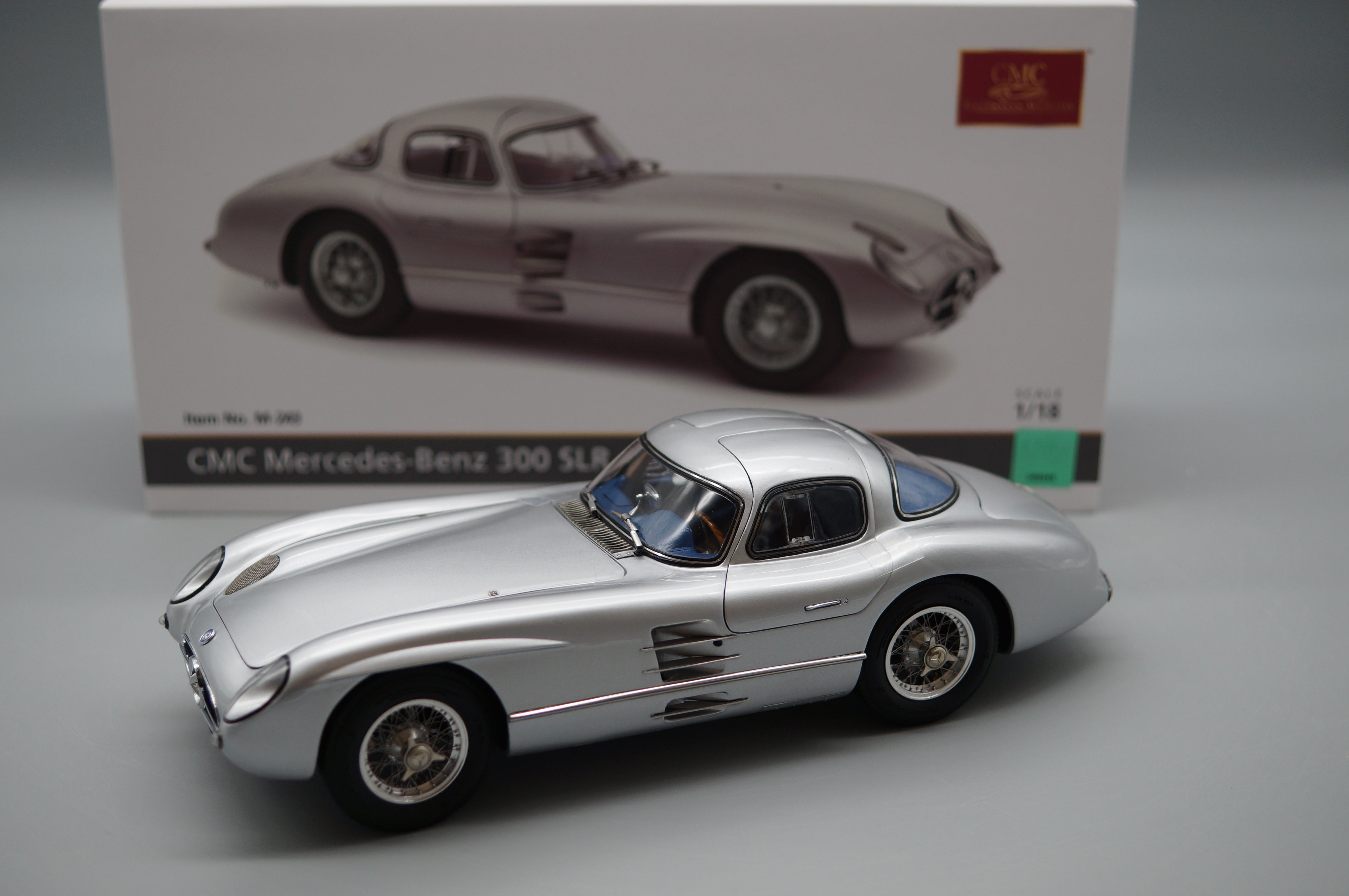
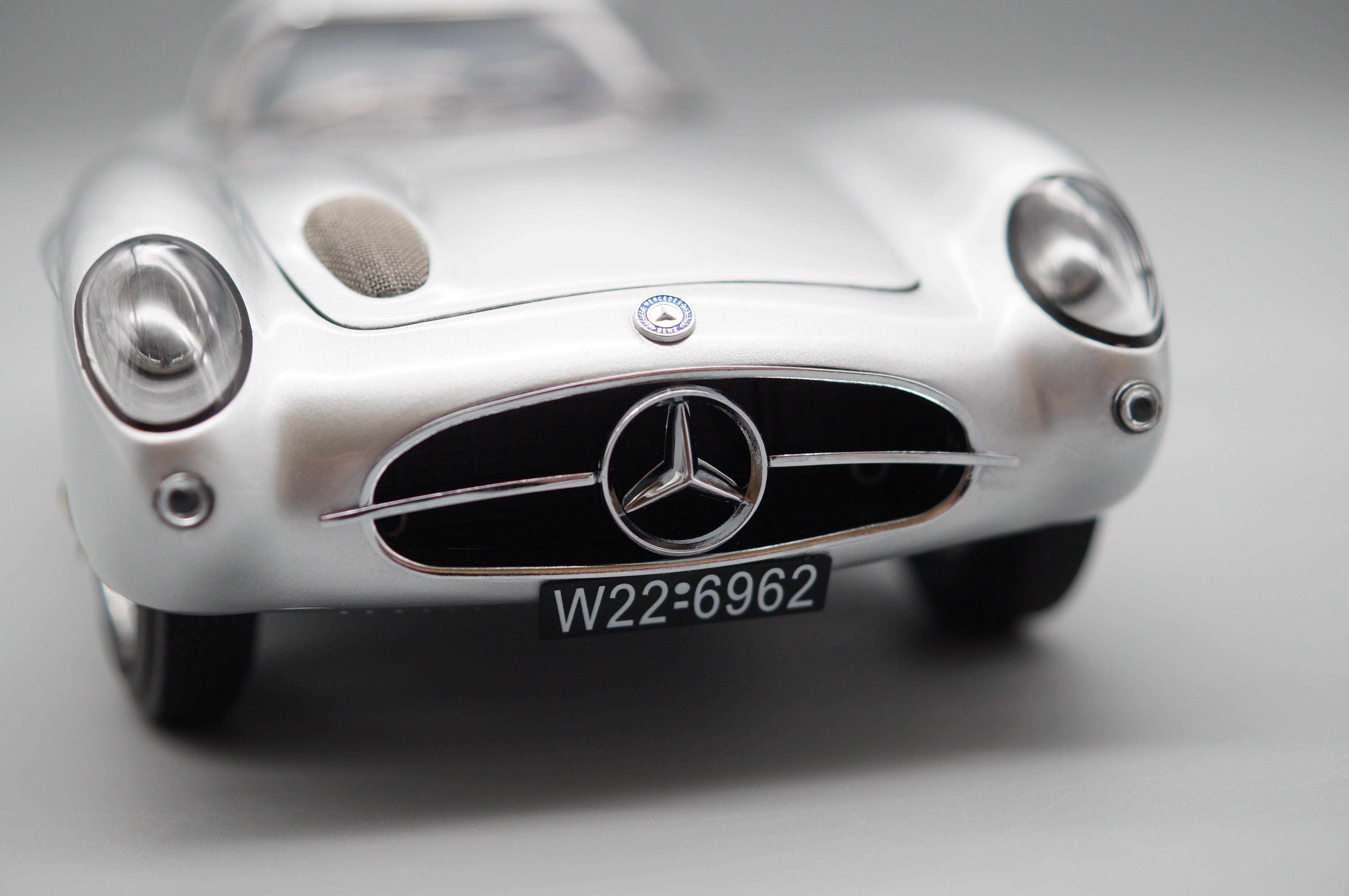
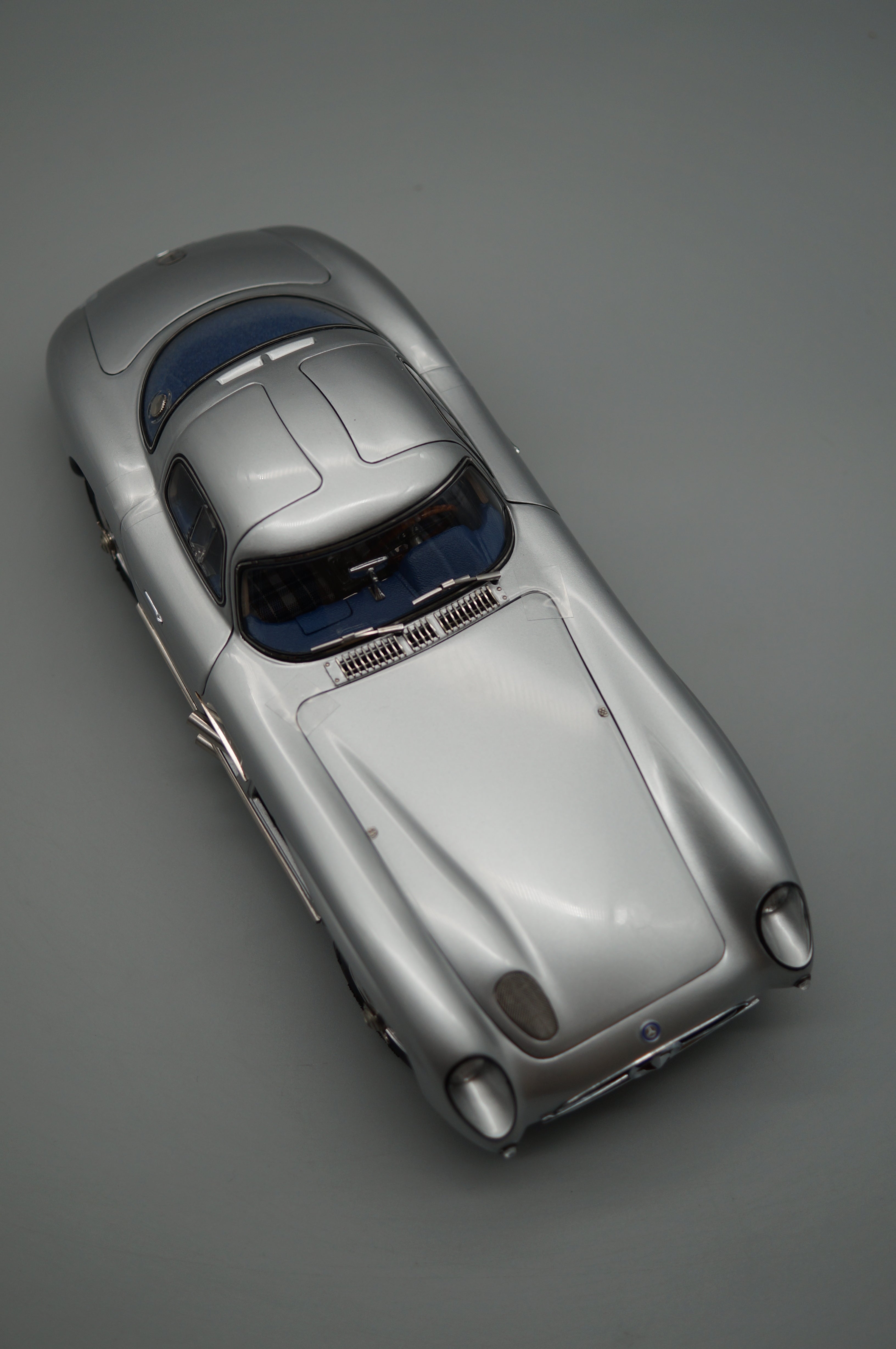
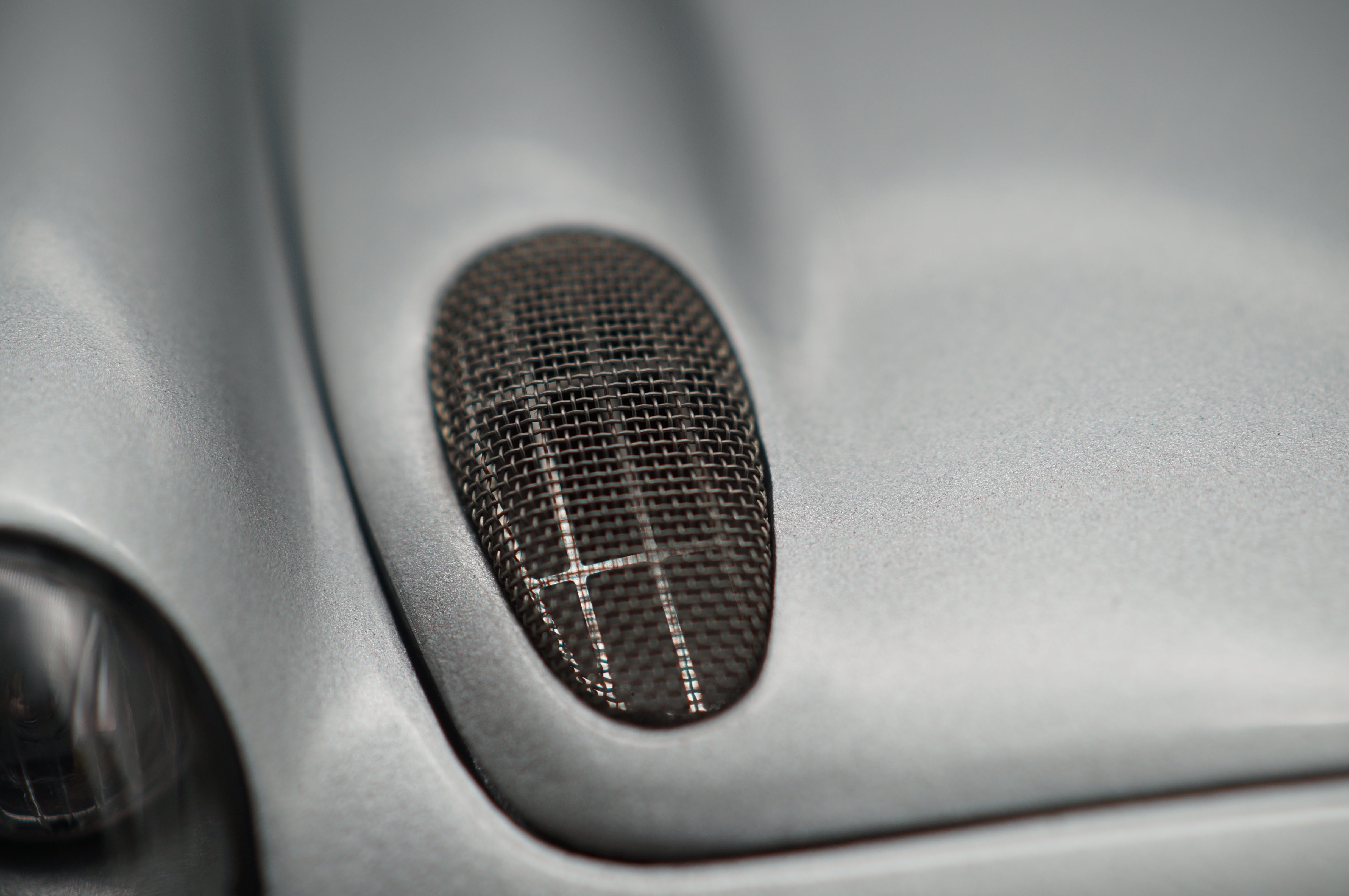
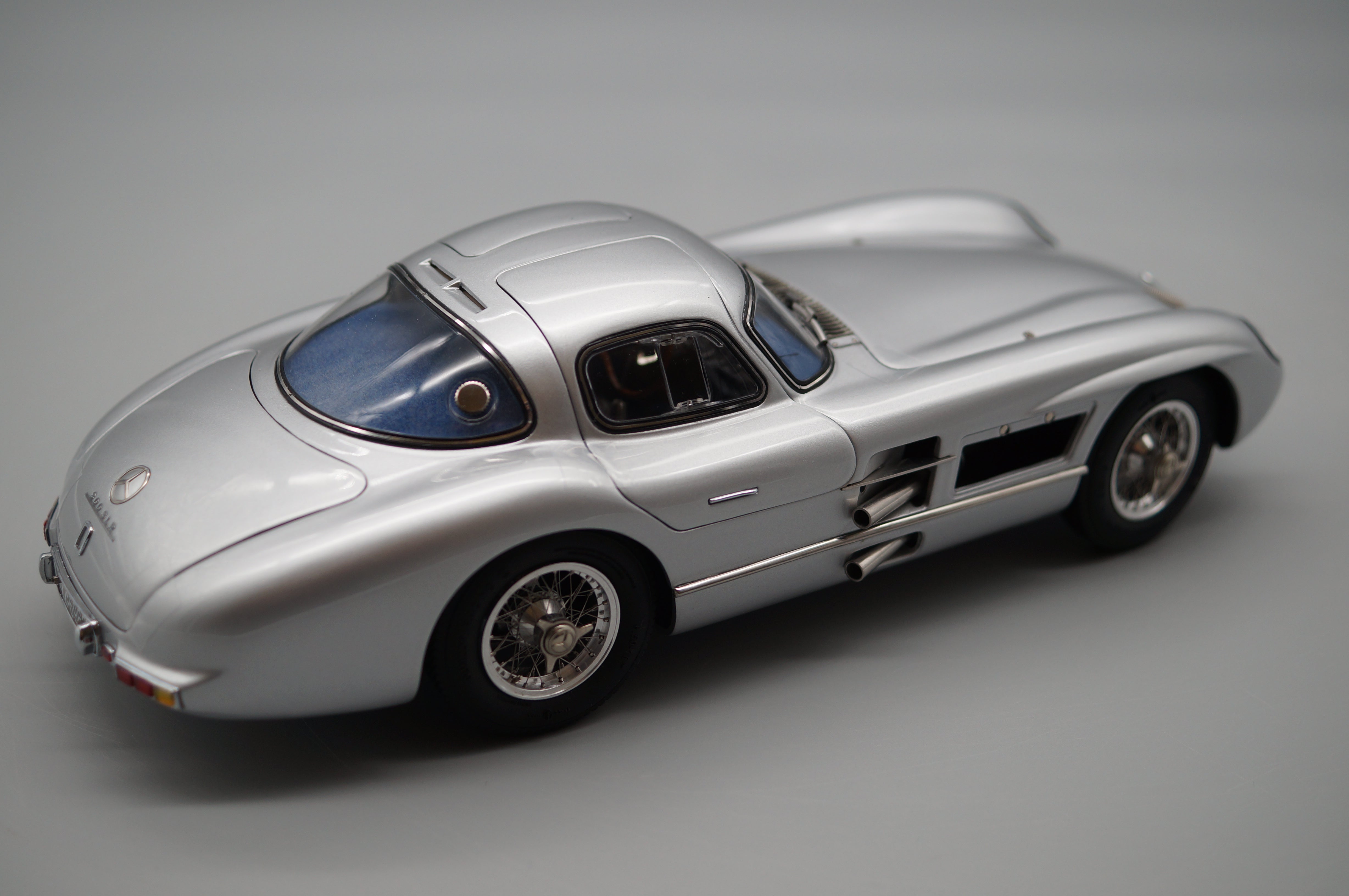
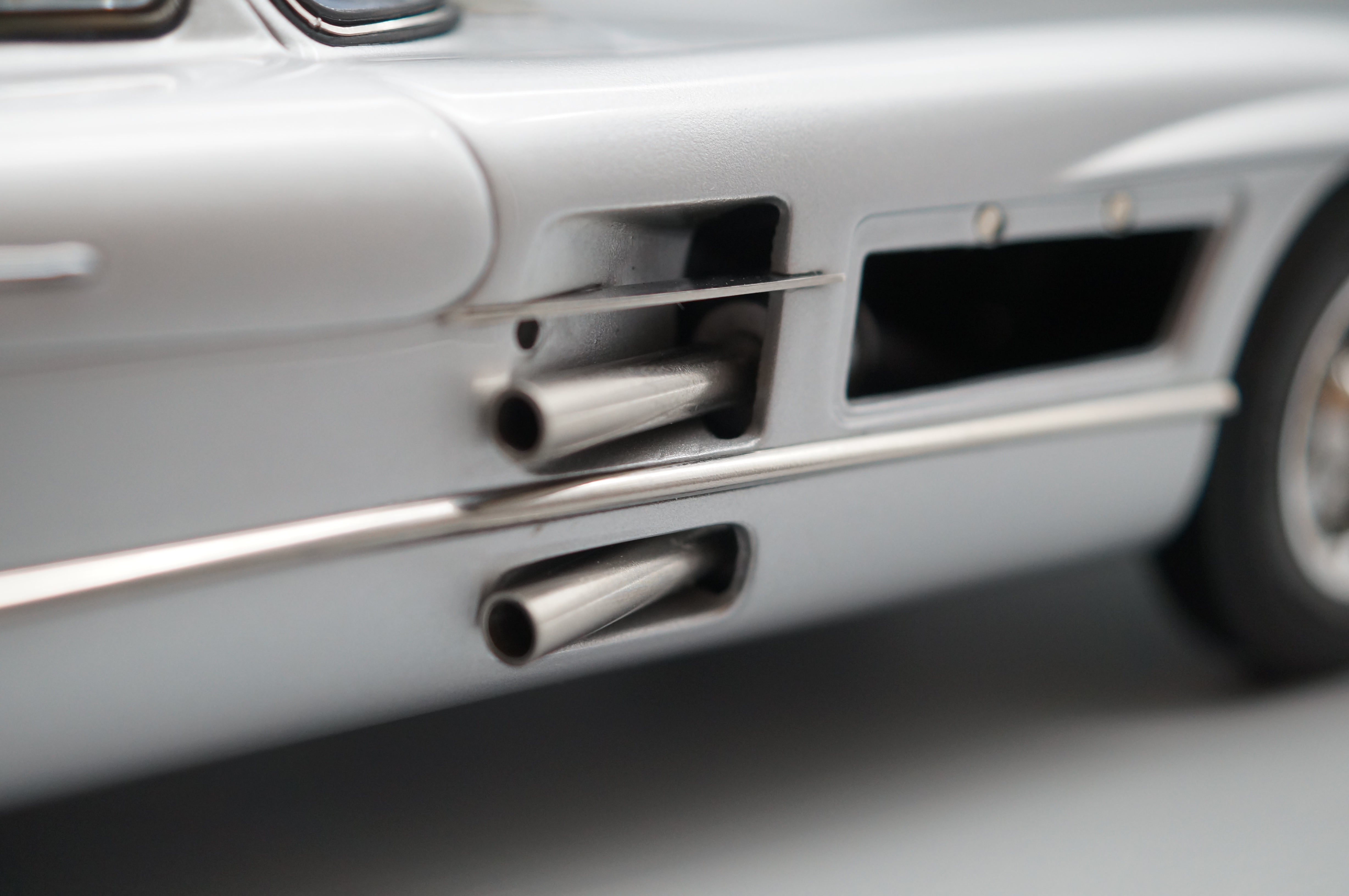
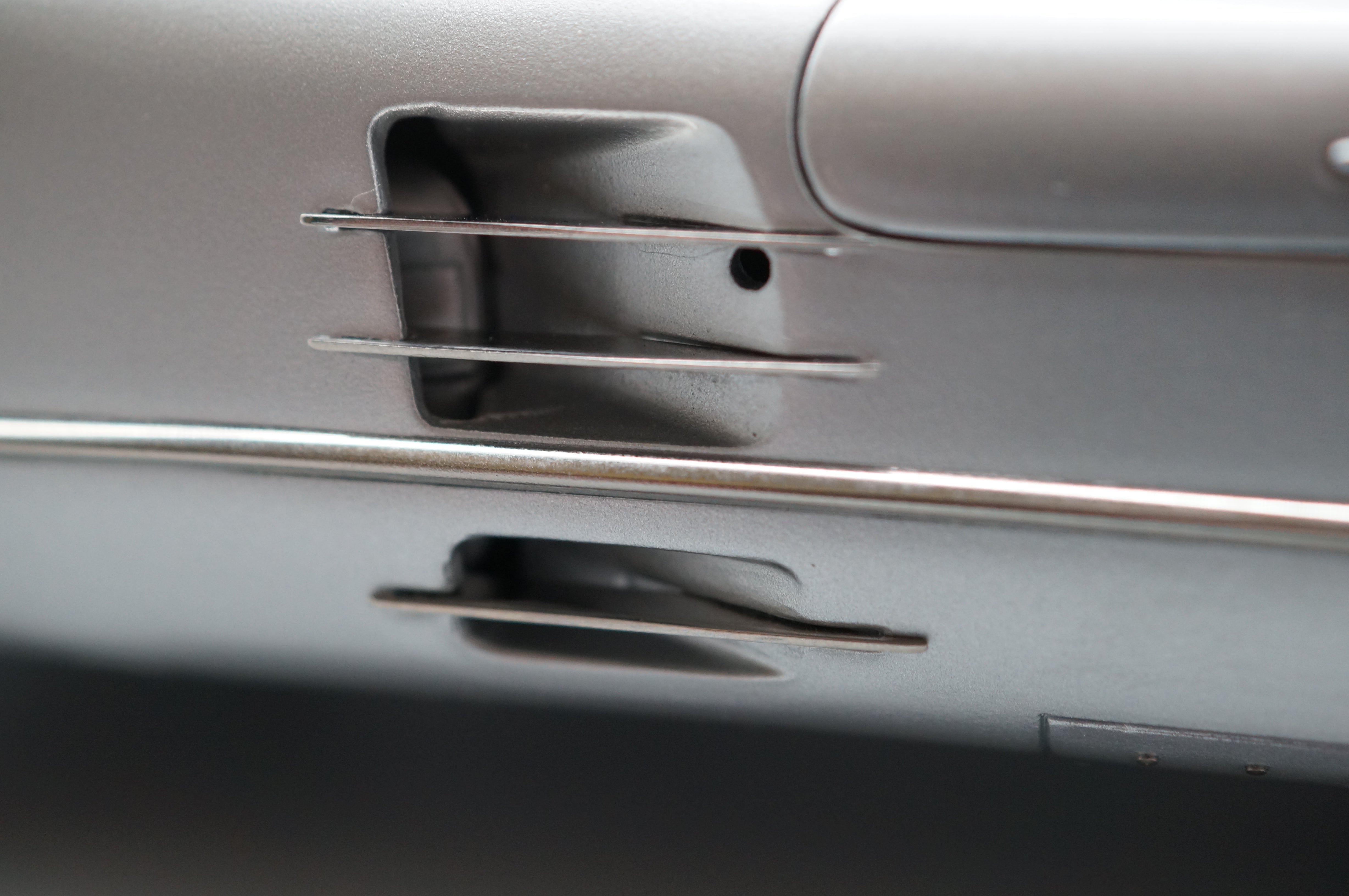
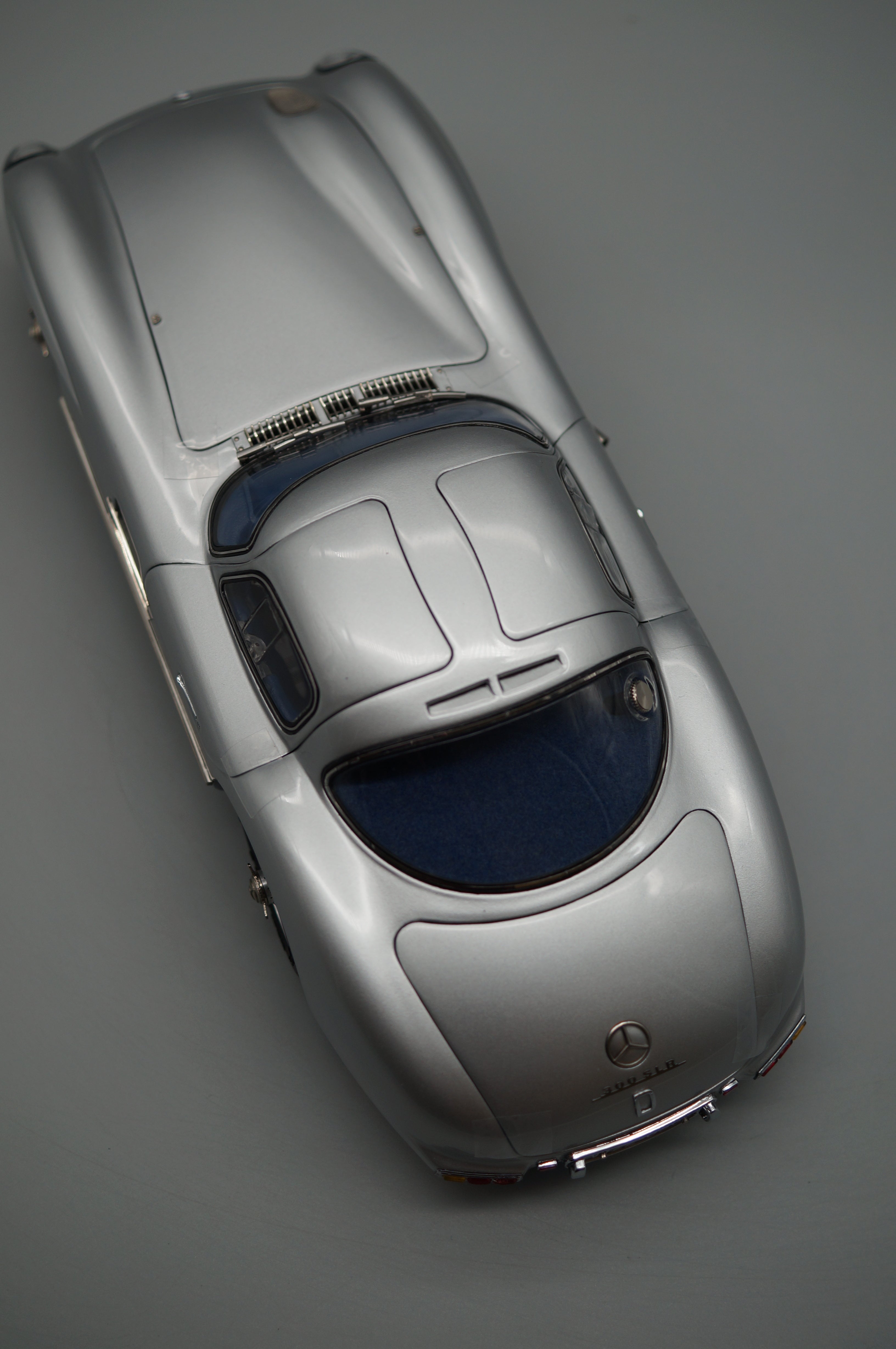
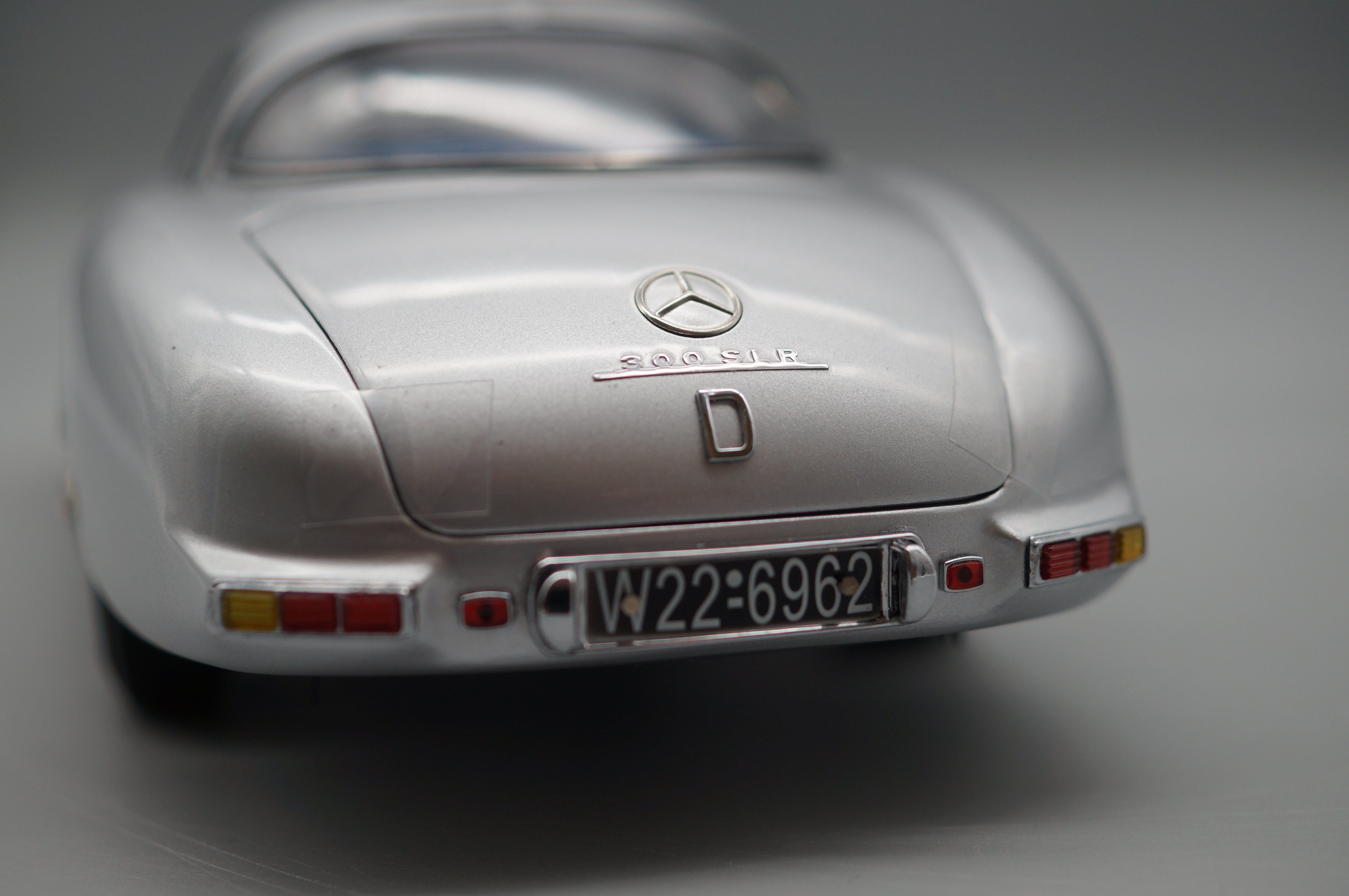
1/18 Mercedes-Benz 300 SLR Coupe 1955 Blue Interior CMC M-243


Description
Model History:
In 1955, when Rudolf Uhlenhaut, the father of the 300 SLR racer, travelled to the Mille Miglia to witness Mercedes' success first-hand, he also considered equipping the 300 SLR racer with a closed cockpit for long-distance events.
His considerations were realised in the form of a competition coupé with a performance that no other road sports car could achieve. During a test on a closed section of the motorway near Munich, the two-seater reached a speed of 290 km/h. Impressed by its exceptional performance during a 3500 km overland drive, the test reporter for the Swiss magazine Automobil Revue said:
“We are driving a car that takes hardly a second to overtake all others and for which 200 km/h on a quiet motorway is hardly more than walking speed. With its insane handling in tight corners, the car seems to defy the laws of centrifugal force…”
The 300 SLR racer was based on the famous W196 Formula 1 championship car of the 1954/55 season. The abbreviation SLR stands for Sport Leicht-Rennen (Sports Light Racing). As one of the most beautiful racing cars of all time, the new SLR was equipped with a slightly different in-line eight-cylinder engine, which was enlarged to 3 litres of displacement. Two of the nine 300 SLR rolling chassis, 0007/55 and 0008/55, were converted into 300 SLR coupés with closed bodies and gullwing doors. They were intended for use in the upcoming Carrera Panamericana.
The body of the SLR coupé was clad with Elektron sheet metal, a magnesium alloy even lighter than aluminium. The semi-circular windshield offered very little air resistance. As with the SLR racer, the coupé driver had to operate the pedals wide-legged behind the steering wheel. Under the bonnet was a longitudinally mounted eight-cylinder engine, placed directly behind the front axle, developing a maximum torque of 234 Nm at 5950 rpm and a maximum output of 310 hp at 7400 rpm.
Due to safety concerns after the tragic accident at Le Mans in June, Mercedes-Benz decided to withdraw from motorsport at the end of the 1955 season. As a result, the SLR coupé project was put on hold and never went into production. Rudolph Uhlenhaut subsequently took one of the SLR Coupés as a company car.
Weighing only 1,117 kg and reaching a speed of 290 km/h, the Uhlenhaut Coupé was by far the fastest road car of its time worldwide.
Although the 300 SLR Coupés were no longer used in actual racing, chassis 0007/55 was no stranger to motorsport. It served as a test car for the factory racing team at the Swedish Grand Prix in June 1955 and the RAC Tourist Trophy in September. At the Targa Florio, the final round of the 1955 Sports Car World Championship, extensive testing was carried out over a total of 16,695 kilometres to familiarise themselves with the 72-kilometre circuit and its 900 curves. The Mercedes team was no exception – Stirling Moss trained tirelessly at the wheel of chassis 0007/55. He damaged the car on the front right; the frame was warped at this point and the wishbones bent. But that did not stop him and Fangio from achieving a double victory with their SLR racers at the Targa Florio on October 16, 1955.
Model Description:
- Hand-assembled precision model made of 1,817 parts
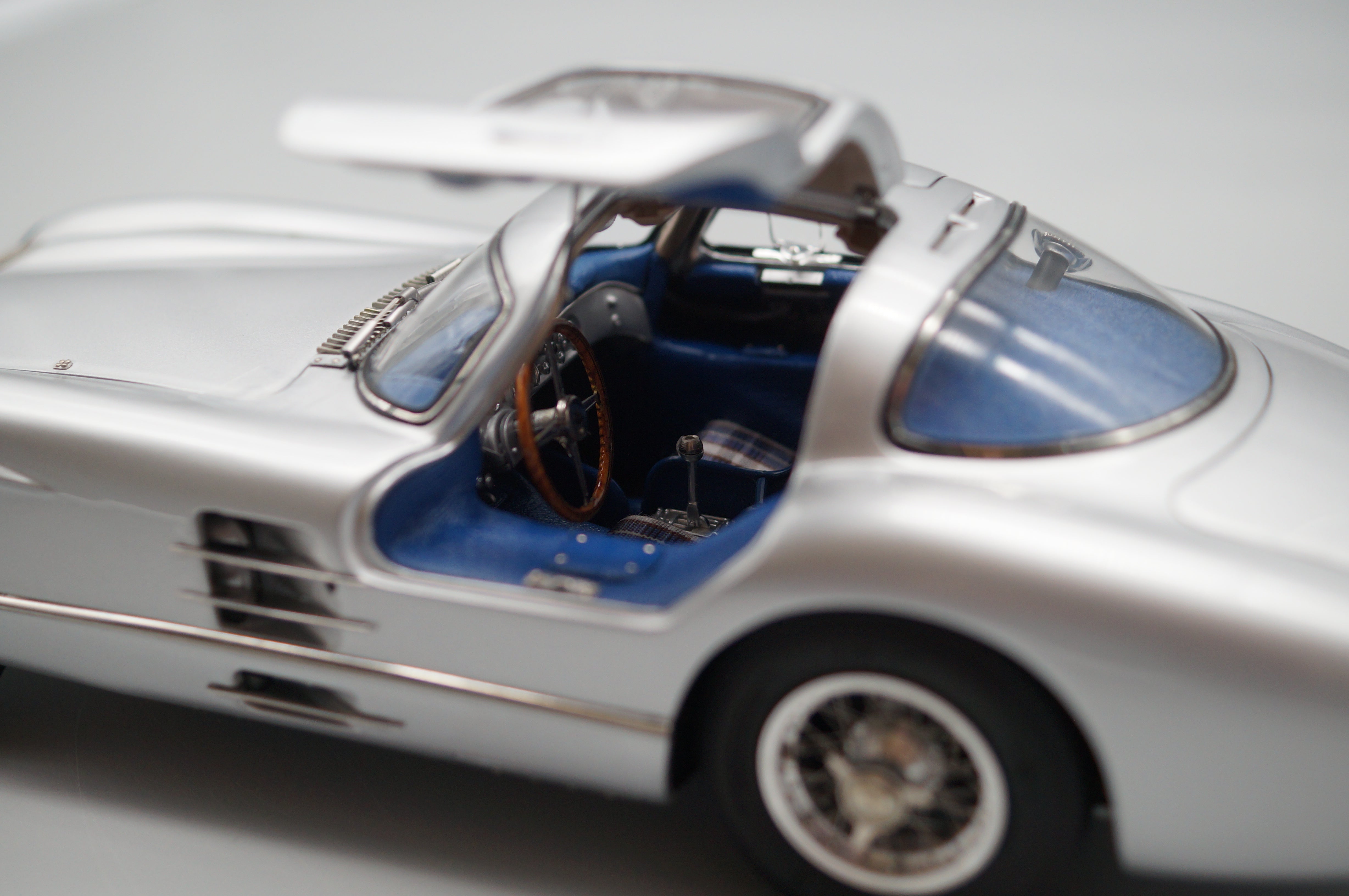
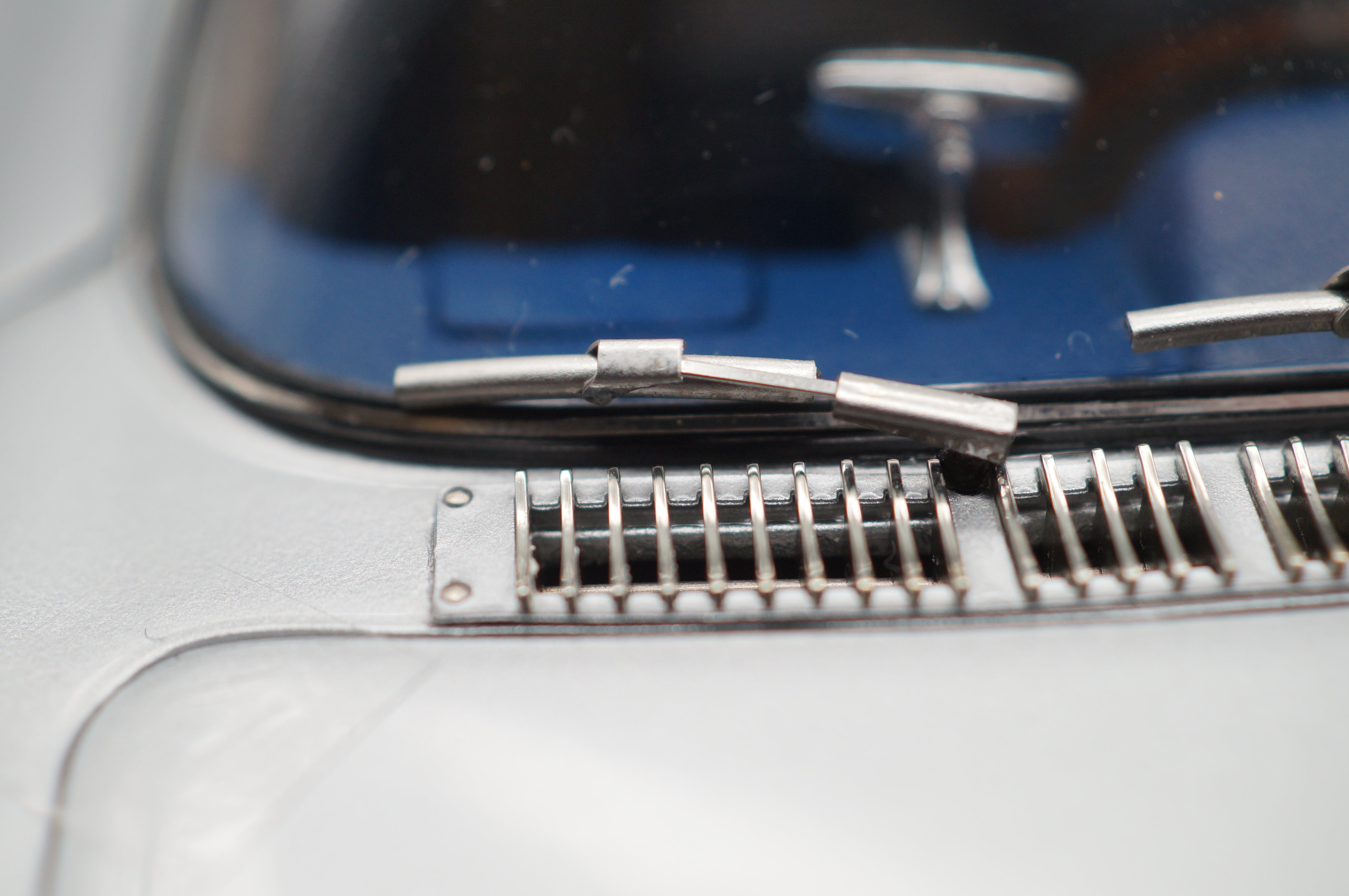
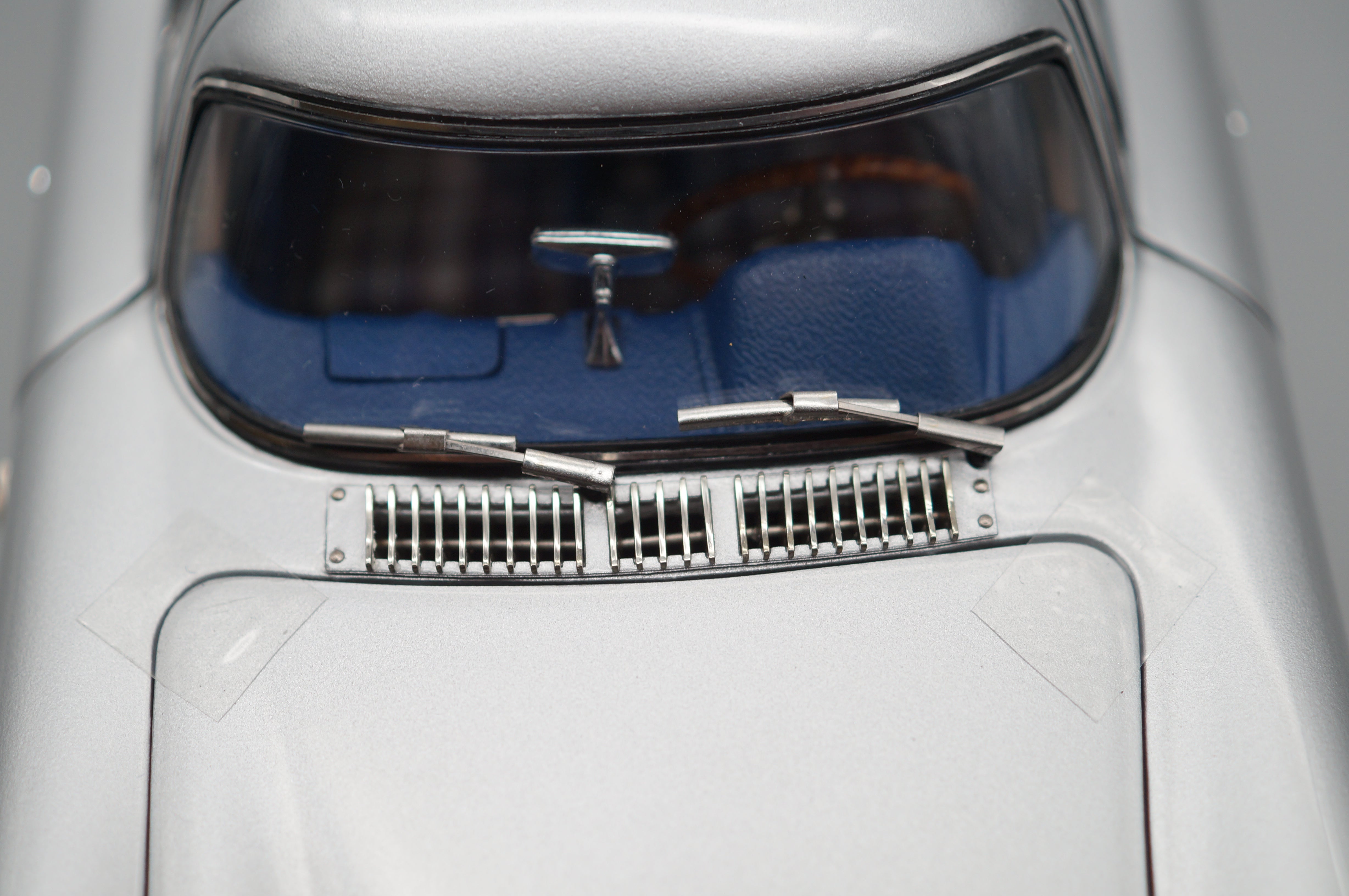
- Authentic and true-to-scale body with functional gullwing doors and swivelling windows
- Precisely constructed tubular space frame made of metal
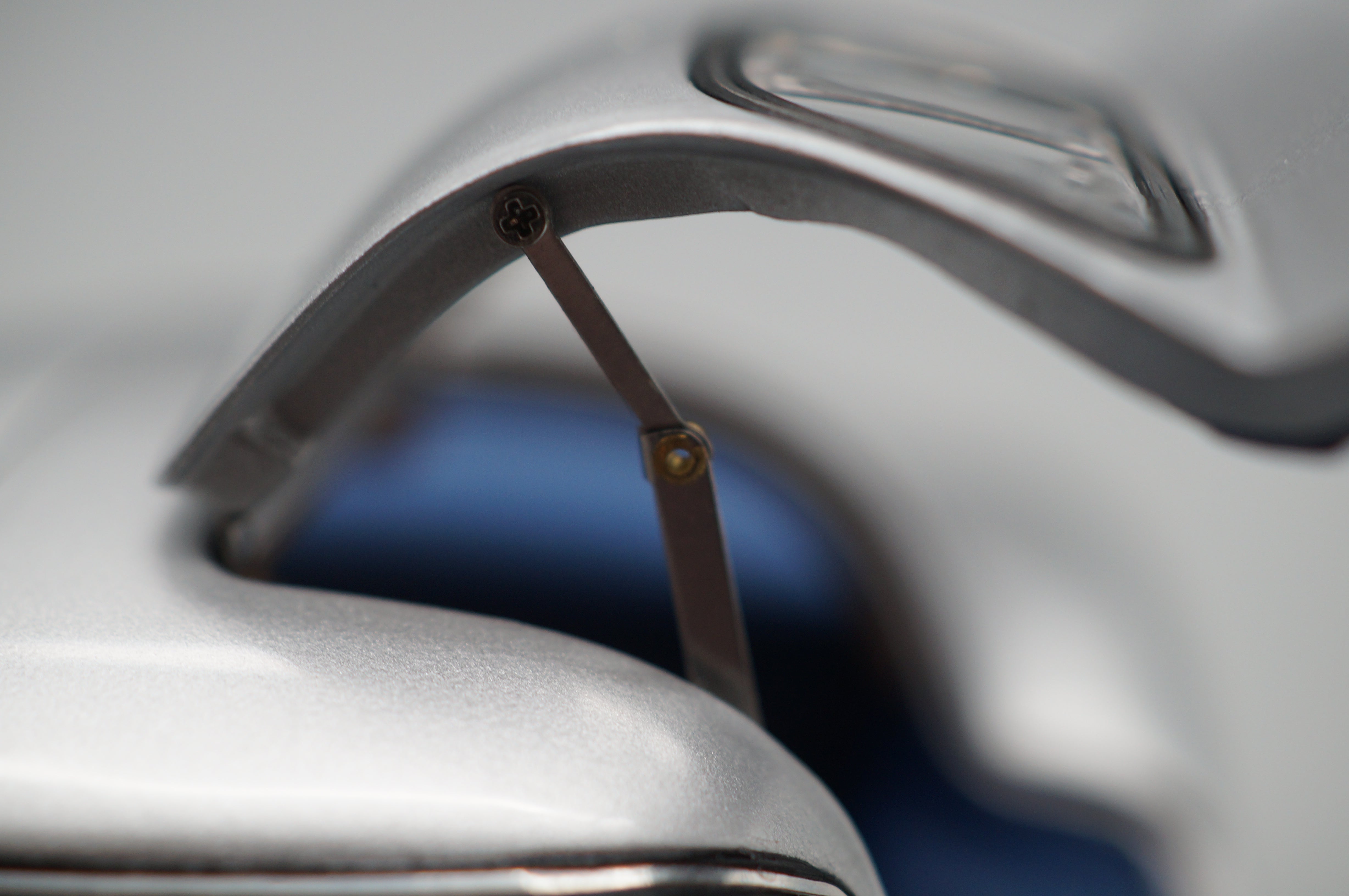
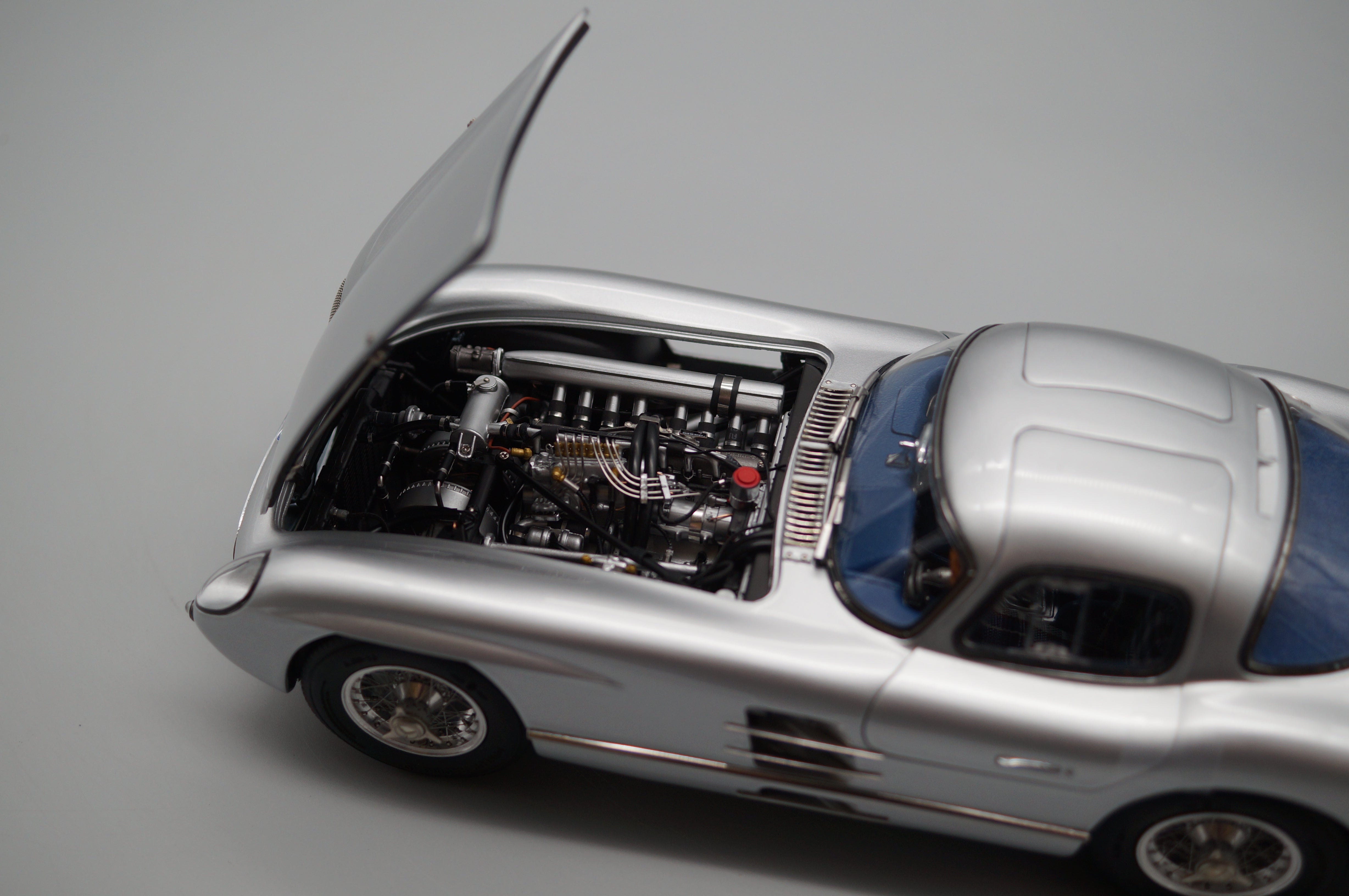
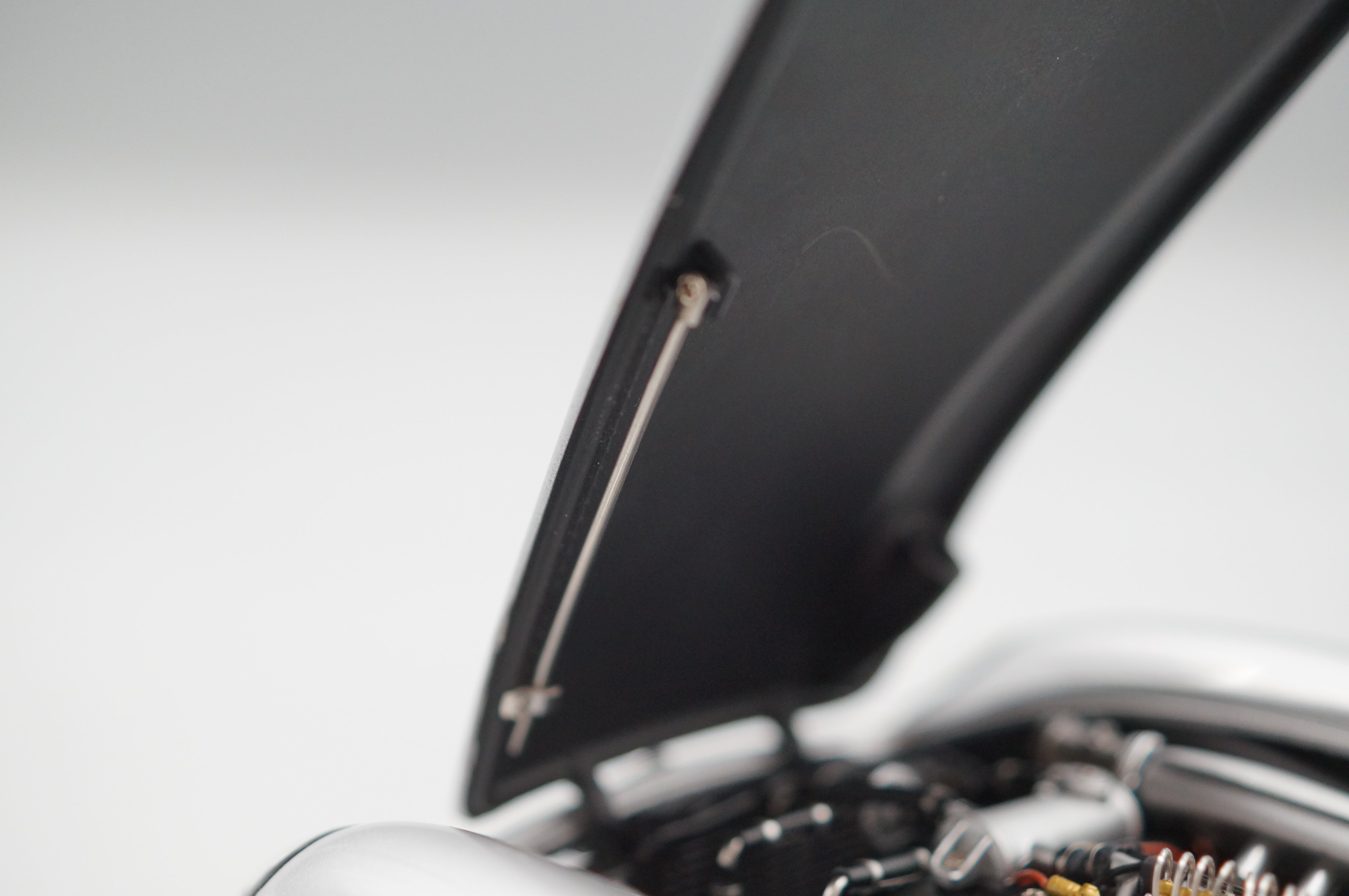
- Hinged bonnet with support rod
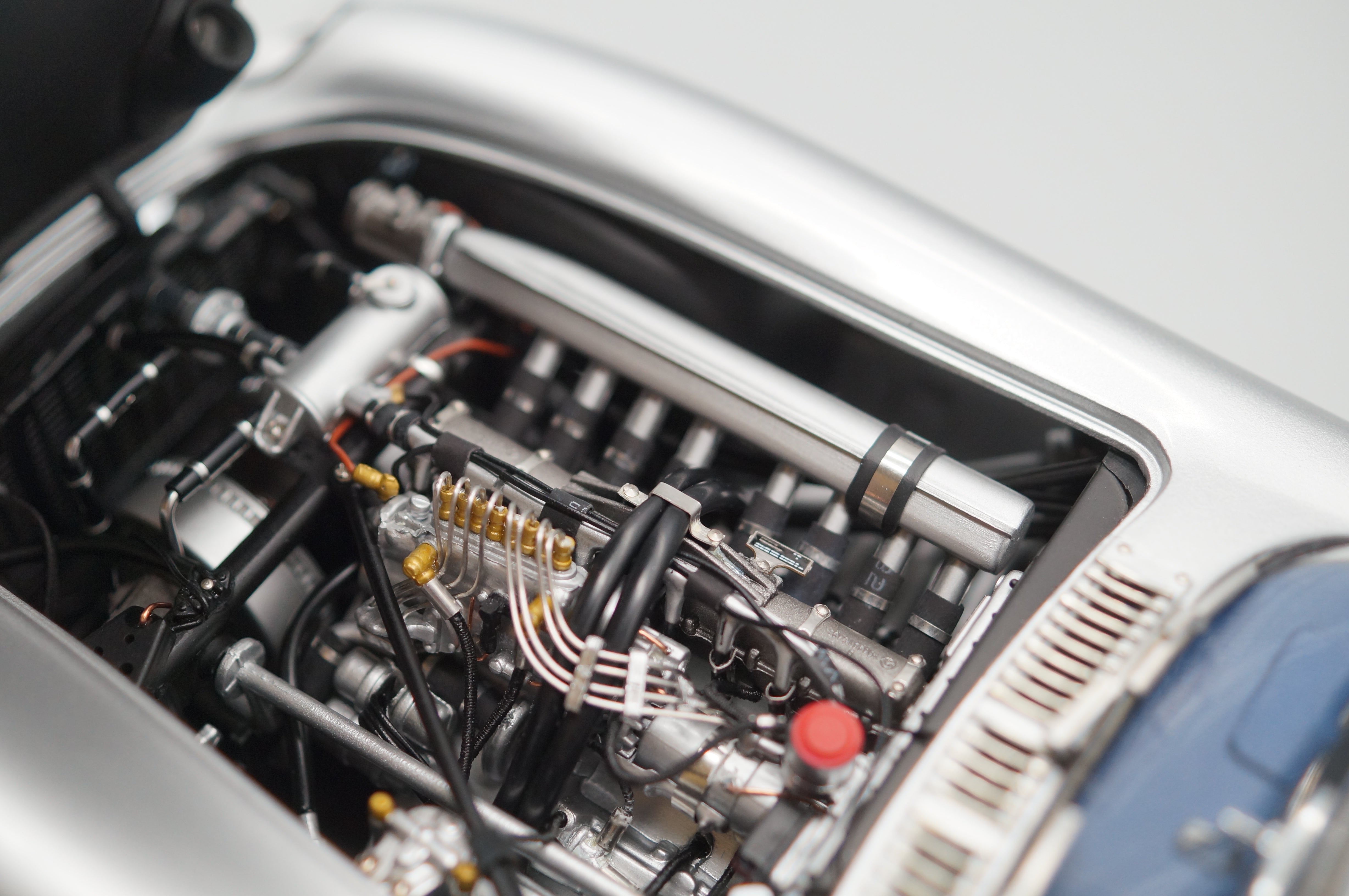
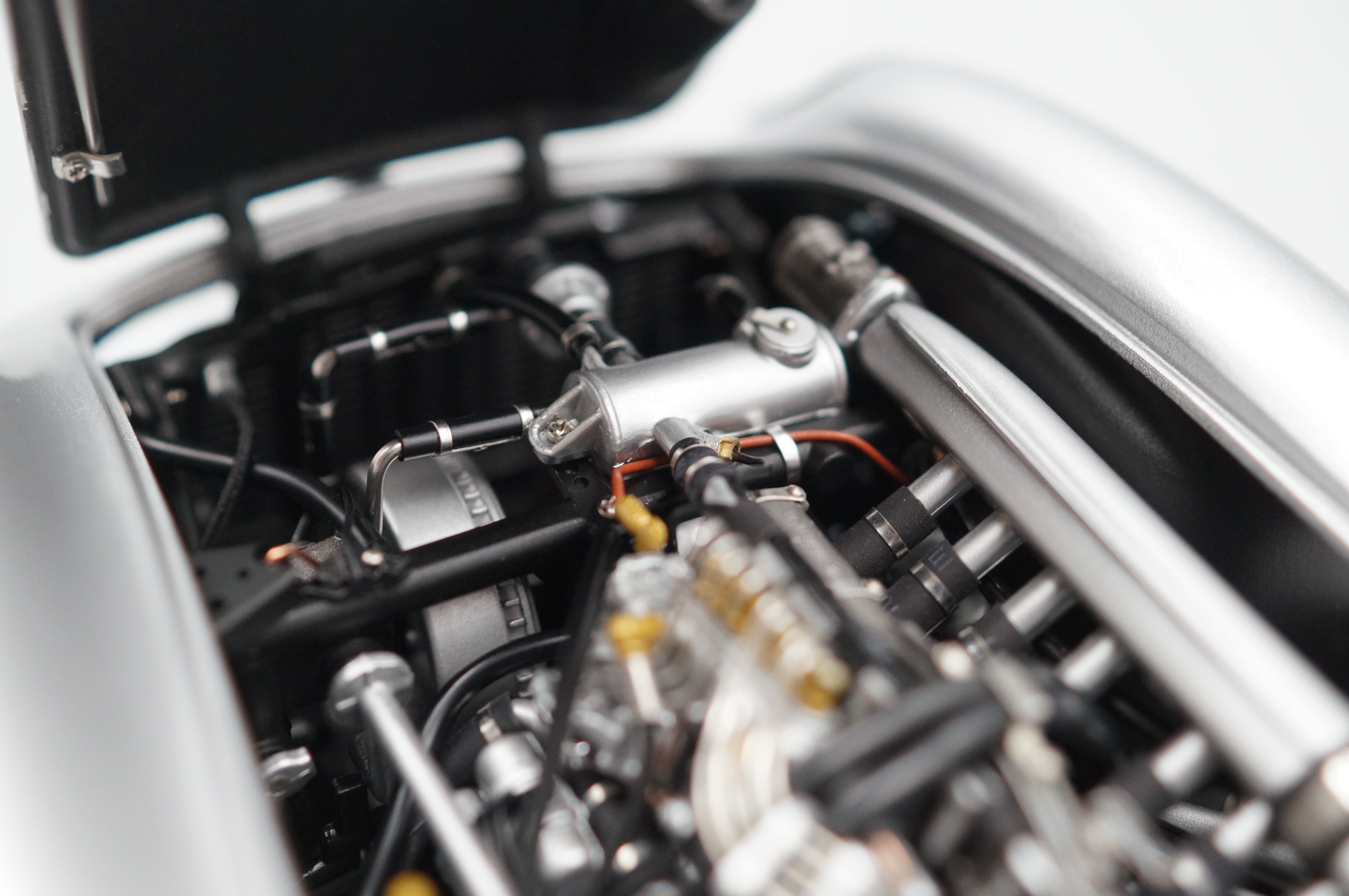
- Highly detailed eight-cylinder in-line engine in inclined installation position, complete with all ancillary components and complete pipework and wiring
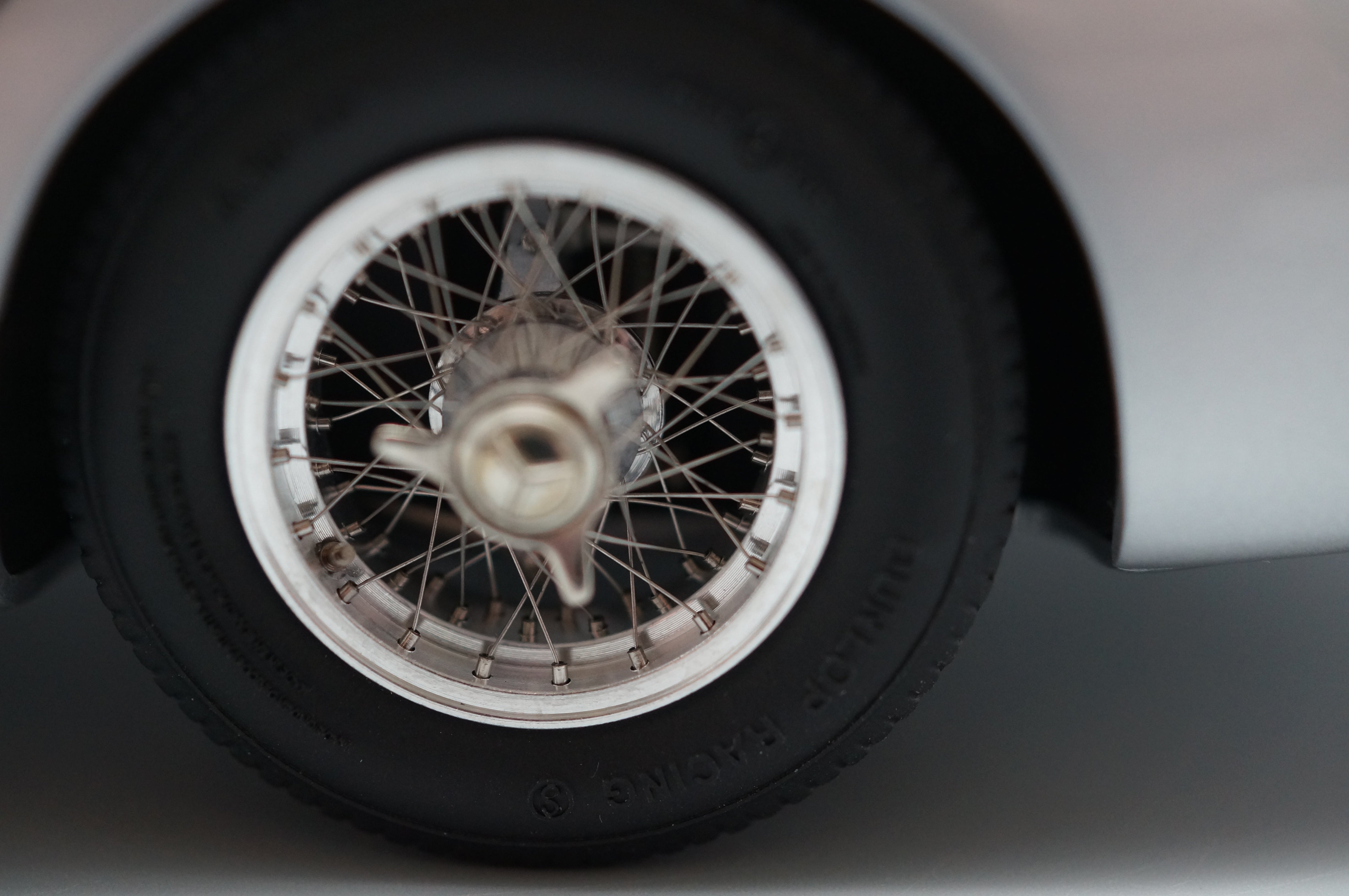
- Hand-assembled spoked wheels with aluminium rims and stainless steel spokes, each mounted on a nipple base
- Removable wheels with central locking nuts, each with side-dependent thread
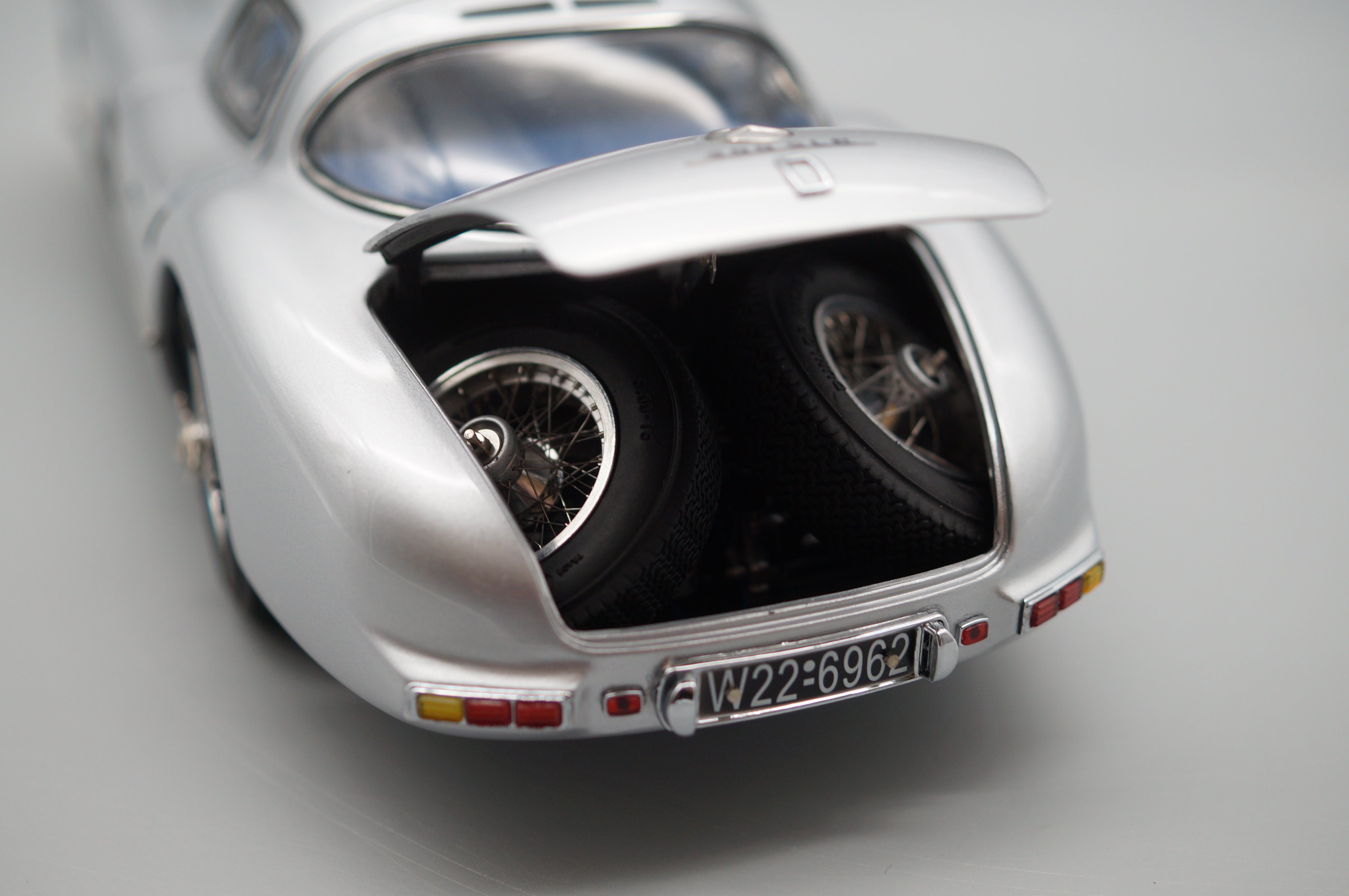
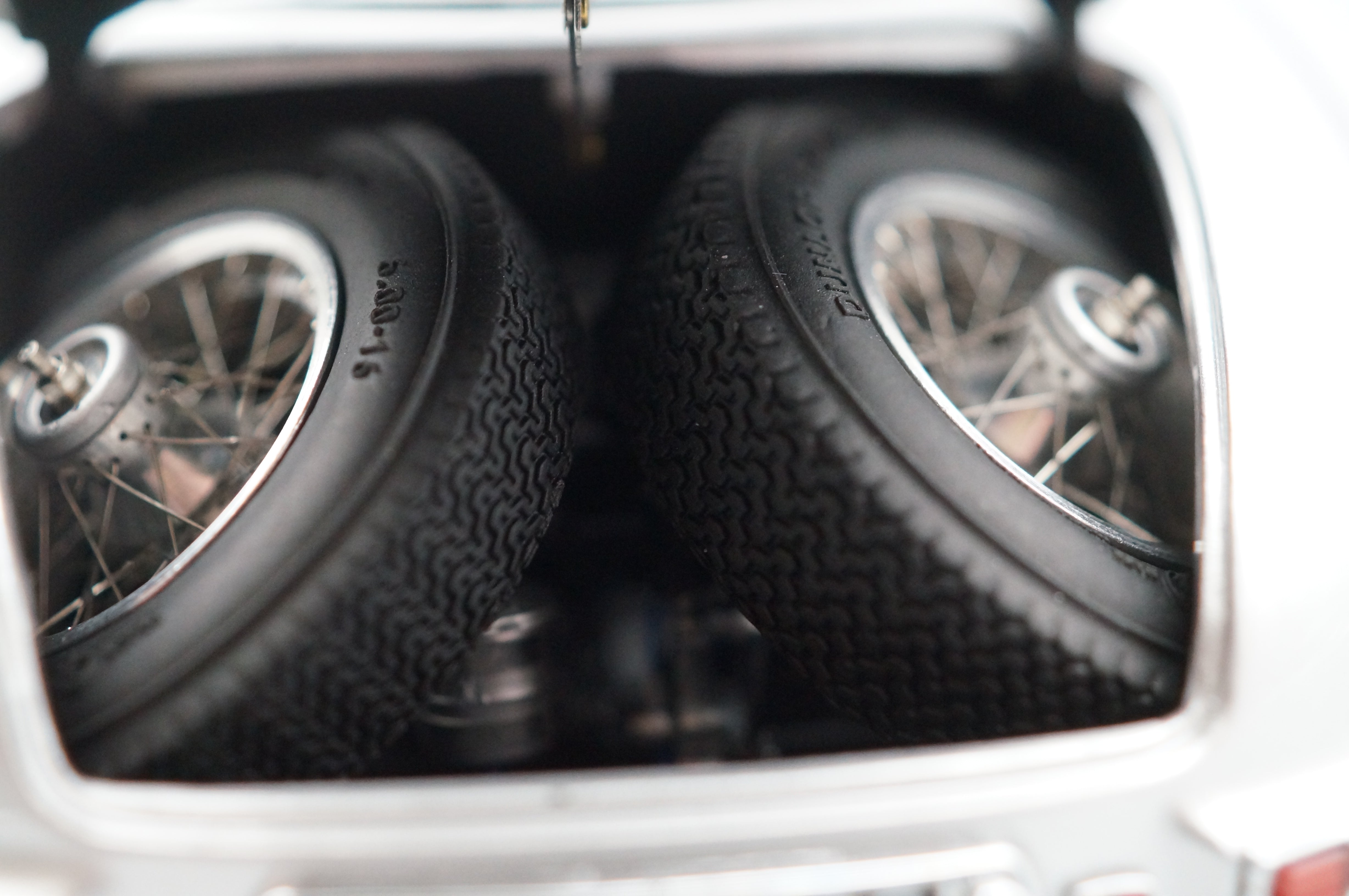
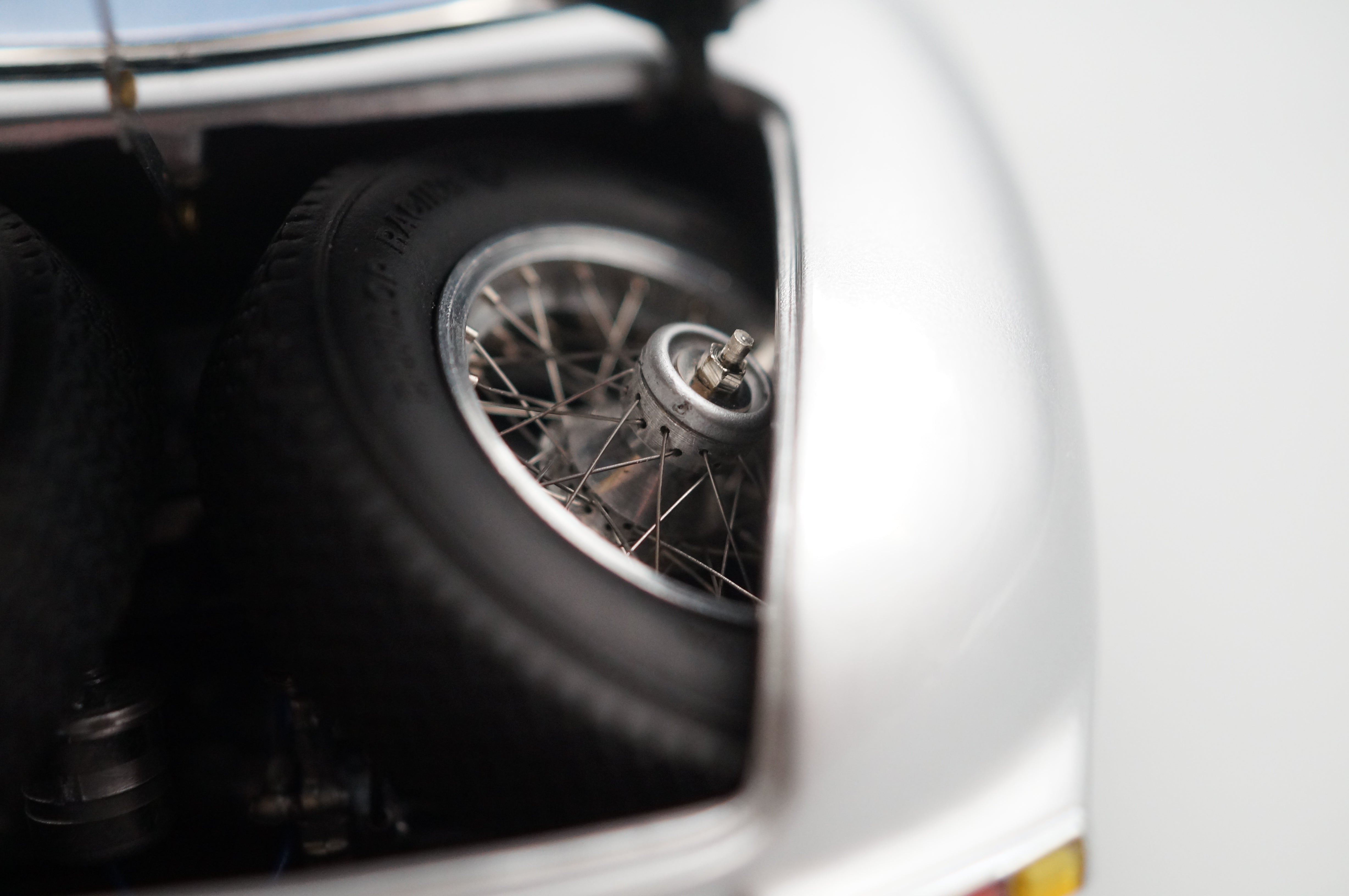
- Two removable spare wheels in the luggage compartment
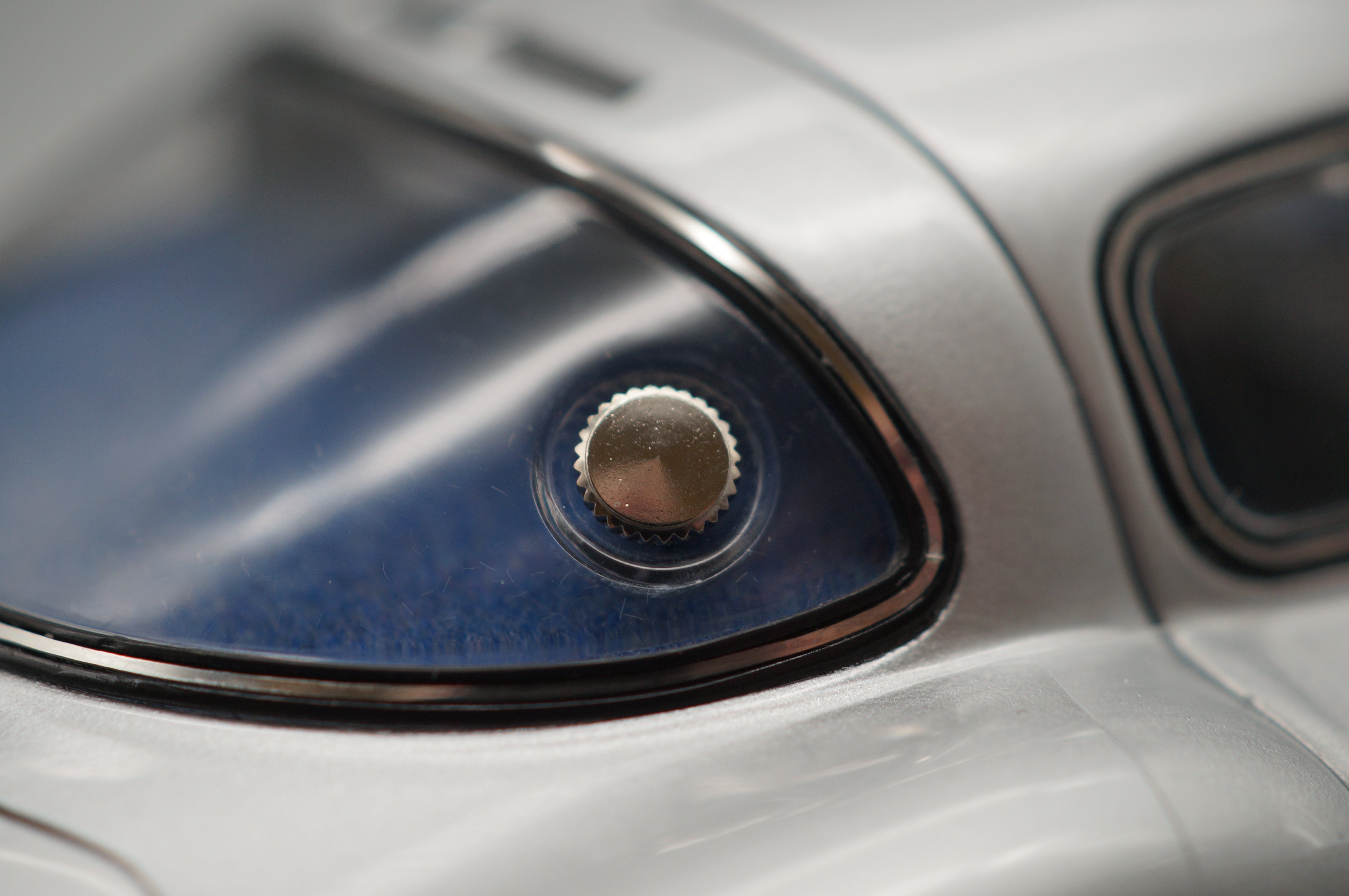
- Fuel filler neck in the rear window
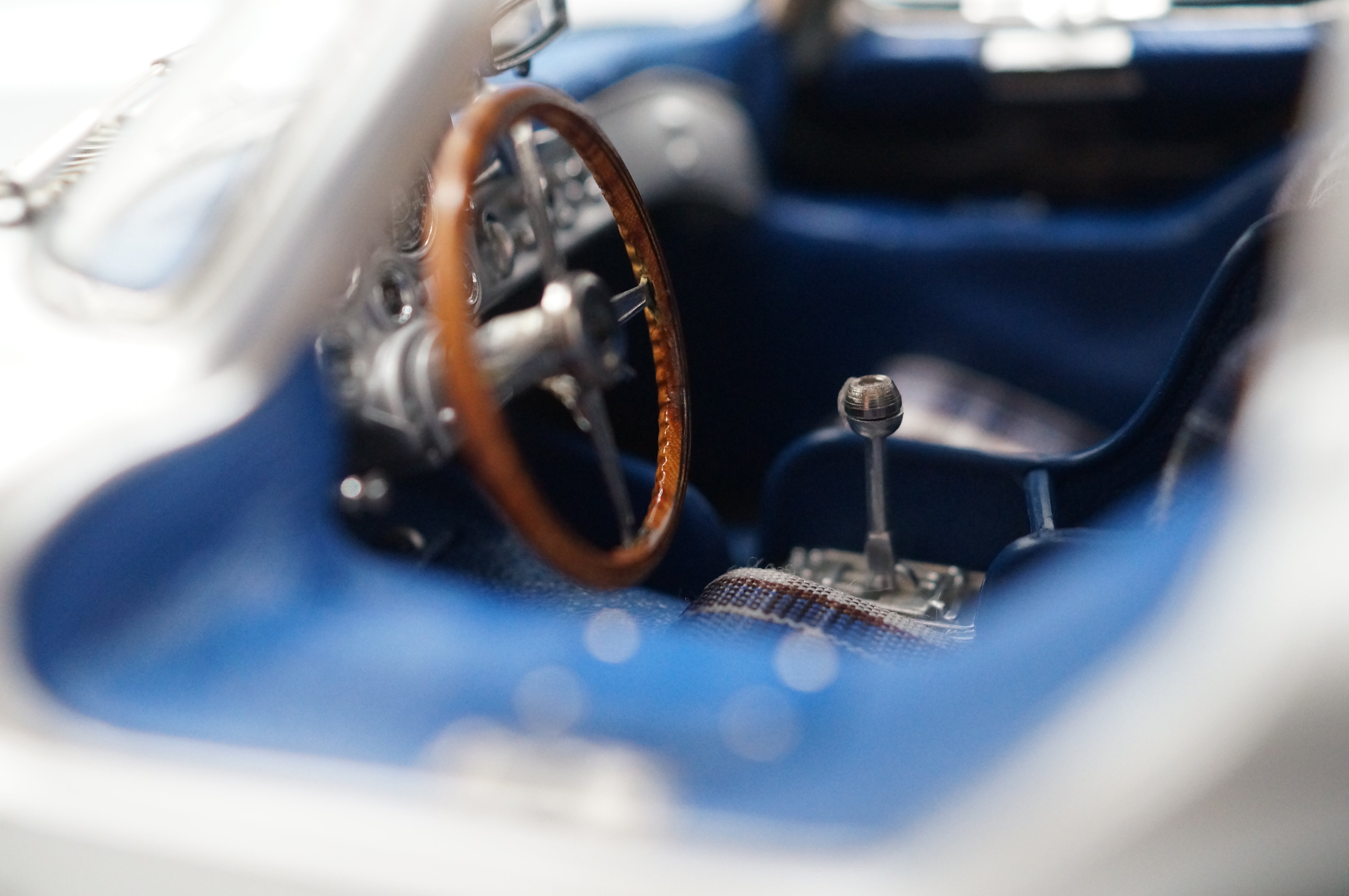
- Finely crafted cockpit with fabric upholstery on the seats and leather interior
- Original-looking dashboard with all gauges and controls
- Stainless steel side exhaust pipes
- Realistic design of front and rear suspension with springs
- Removable engine maintenance hatch on the right side of the vehicle (supplied unassembled)
Original Vehicle Data:
Eight-cylinder in-line engine (installation angle: 33° inclination to the right)
Petrol direct injection
Desmodromic valve control (force-controlled valves)
Chassis: front wishbones, rear single-joint swing axle
Power: 300 hp at 7,600 rpm
Displacement: 2,982 cc
Top speed: approx. 300 km/h
Wheelbase: 2,370 mm
Overall length: 4,315 mm
Not suitable for children under 14 years. May contain small and sharp parts.
Notice
Model History:
In 1955, when Rudolf Uhlenhaut, the father of the 300 SLR racer, travelled to the Mille Miglia to witness Mercedes' success first-hand, he also considered equipping the 300 SLR racer with a closed cockpit for long-distance events.
His considerations were realised in the form of a competition coupé with a performance that no other road sports car could achieve. During a test on a closed section of the motorway near Munich, the two-seater reached a speed of 290 km/h. Impressed by its exceptional performance during a 3500 km overland drive, the test reporter for the Swiss magazine Automobil Revue said:
“We are driving a car that takes hardly a second to overtake all others and for which 200 km/h on a quiet motorway is hardly more than walking speed. With its insane handling in tight corners, the car seems to defy the laws of centrifugal force…”
The 300 SLR racer was based on the famous W196 Formula 1 championship car of the 1954/55 season. The abbreviation SLR stands for Sport Leicht-Rennen (Sports Light Racing). As one of the most beautiful racing cars of all time, the new SLR was equipped with a slightly different in-line eight-cylinder engine, which was enlarged to 3 litres of displacement. Two of the nine 300 SLR rolling chassis, 0007/55 and 0008/55, were converted into 300 SLR coupés with closed bodies and gullwing doors. They were intended for use in the upcoming Carrera Panamericana.
The body of the SLR coupé was clad with Elektron sheet metal, a magnesium alloy even lighter than aluminium. The semi-circular windshield offered very little air resistance. As with the SLR racer, the coupé driver had to operate the pedals wide-legged behind the steering wheel. Under the bonnet was a longitudinally mounted eight-cylinder engine, placed directly behind the front axle, developing a maximum torque of 234 Nm at 5950 rpm and a maximum output of 310 hp at 7400 rpm.
Due to safety concerns after the tragic accident at Le Mans in June, Mercedes-Benz decided to withdraw from motorsport at the end of the 1955 season. As a result, the SLR coupé project was put on hold and never went into production. Rudolph Uhlenhaut subsequently took one of the SLR Coupés as a company car.
Weighing only 1,117 kg and reaching a speed of 290 km/h, the Uhlenhaut Coupé was by far the fastest road car of its time worldwide.
Although the 300 SLR Coupés were no longer used in actual racing, chassis 0007/55 was no stranger to motorsport. It served as a test car for the factory racing team at the Swedish Grand Prix in June 1955 and the RAC Tourist Trophy in September. At the Targa Florio, the final round of the 1955 Sports Car World Championship, extensive testing was carried out over a total of 16,695 kilometres to familiarise themselves with the 72-kilometre circuit and its 900 curves. The Mercedes team was no exception – Stirling Moss trained tirelessly at the wheel of chassis 0007/55. He damaged the car on the front right; the frame was warped at this point and the wishbones bent. But that did not stop him and Fangio from achieving a double victory with their SLR racers at the Targa Florio on October 16, 1955.
Model Description:
- Hand-assembled precision model made of 1,817 parts
- Authentic and true-to-scale body with functional gullwing doors and swivelling windows
- Precisely constructed tubular space frame made of metal
- Hinged bonnet with support rod
- Highly detailed eight-cylinder in-line engine in inclined installation position, complete with all ancillary components and complete pipework and wiring
- Hand-assembled spoked wheels with aluminium rims and stainless steel spokes, each mounted on a nipple base
- Removable wheels with central locking nuts, each with side-dependent thread
- Two removable spare wheels in the luggage compartment
- Fuel filler neck in the rear window
- Finely crafted cockpit with fabric upholstery on the seats and leather interior
- Original-looking dashboard with all gauges and controls
- Stainless steel side exhaust pipes
- Realistic design of front and rear suspension with springs
- Removable engine maintenance hatch on the right side of the vehicle (supplied unassembled)
Original Vehicle Data:
Eight-cylinder in-line engine (installation angle: 33° inclination to the right)
Petrol direct injection
Desmodromic valve control (force-controlled valves)
Chassis: front wishbones, rear single-joint swing axle
Power: 300 hp at 7,600 rpm
Displacement: 2,982 cc
Top speed: approx. 300 km/h
Wheelbase: 2,370 mm
Overall length: 4,315 mm
Not suitable for children under 14 years. May contain small and sharp parts.